What’s the Best Time To Eat Breakfast?

For optimal health, timing is everything — whether you’re getting seven or more hours of sleep per night, exercising for at least 150 minutes a week, or taking medications at the proper time of day. Research shows that you can add meal timing to that list, too.
Scientists have known for decades that meal timing, the practice of strategically timing meals in alignment with your circadian rhythm for efficient metabolism, is indirectly related to heart health, according to Ethan Balk, Ph.D., a clinical associate professor in NYU Steinhardt’s Department of Nutrition and Food Studies.
“Eating an earlier meal or a breakfast at the beginning of the day holds numerous health benefits,” he says.
A new study in the European Journal of Clinical Nutrition drills down on that relationship, pinpointing the window of time for eating breakfast that’s associated with the lowest risk of death from cardiovascular disease with data from a massive longitudinal study.

Eating Around the Clock
The science of meal timing, aka chrononutrition, is based on the human body’s circadian rhythm. (“Circadian” is a portmanteau of the Latin words for “about” and “a day,” referring to the roughly 24-hour nature of the rhythm.) This internal clock is connected to light-sensitive cells in the brain’s hypothalamus, which send and receive signals to regulate sleeping and waking, digestion, hormone levels, and body temperature at optimized times during a 24-hour period.
Though each person’s clock is slightly different, human circadian rhythms are strongly linked to the natural cycle of day and night. When the sun rises in the morning, your eyes sense the light and signal your brain to suppress the sleep-related hormone melatonin and increase production of cortisol, a hormone that promotes alertness and primes your metabolism to efficiently process your first meal of the day.

Reader Favorites




A Better Breakfast Hour
In the new study, scientists wanted to identify the breakfast time associated with better heart health and longevity using data from the National Health and Nutrition Examination Survey (NHANES), collected between 1999 and 2018. Researchers examined mealtime and health reports from 31,044 adults ages 40 or older in the U.S. After their initial interview, each participant was reinterviewed after a term ranging from 4.5 to 13 years. The survey recorded 7,129 deaths in the follow-up periods.
Compared with a first meal timed between 7 a.m. and 8 a.m., the data showed that eating the first meal of the day as near to, but not before, 7 a.m. was associated with lower risks of dying from heart disease — or from any reason. The same was largely true for the last meal of the day: Compared to eating between 7 p.m. and 8 p.m., dining after midnight was associated with a 51% higher risk of death from heart disease. Let’s look at how each breakfast time reflected mortality risk:
Risk of Death From Cardiovascular Disease
| Time of First Meal of the Day | Hazard Ratio (the Lower, the Better) |
| 7 a.m. to 8 a.m. | Control |
| 8 a.m. to 10 a.m. | 1.16 |
| 10 a.m. to 12 p.m. | 1.26 |
| After 12 p.m. | 1.46 |
Risk of Death From Any Cause
| Time of First Meal of the Day | Hazard Ratio (the Lower, the Better) |
| 7 a.m. to 8 a.m. | Control |
| 8 a.m. to 10 a.m. | 1.10 |
| 10 a.m. to 12 p.m. | 1.19 |
| After 12 p.m. | 1.29 |
Compared with breakfast between 7 and 8 a.m., having breakfast after noon was “associated with a 43% higher risk of death from heart disease,” as well as “a 29% higher risk of death from any cause, and a loss of 2.5 years of life expectancy at age 50,” the authors write.

Should You Eat Earlier?
Multiple factors can influence when you eat the first meal of the day, such as working morning or night shifts, caring for family members, food security, and simple personal preference. Because of that, there’s no one universal “best” time to eat breakfast, but some evidence does seem to suggest you may not want to skip it. One 2025 study, for example, found a link between missing breakfast and metabolic syndrome. Another 2025 review suggested that skipping the meal may disrupt your gut microbiome and contribute to inflammation, among other negative effects The findings in this study are a step toward understanding the association between earlier meal times and lower risk of cardiovascular disease and death, says Balk, who was not involved in the research.
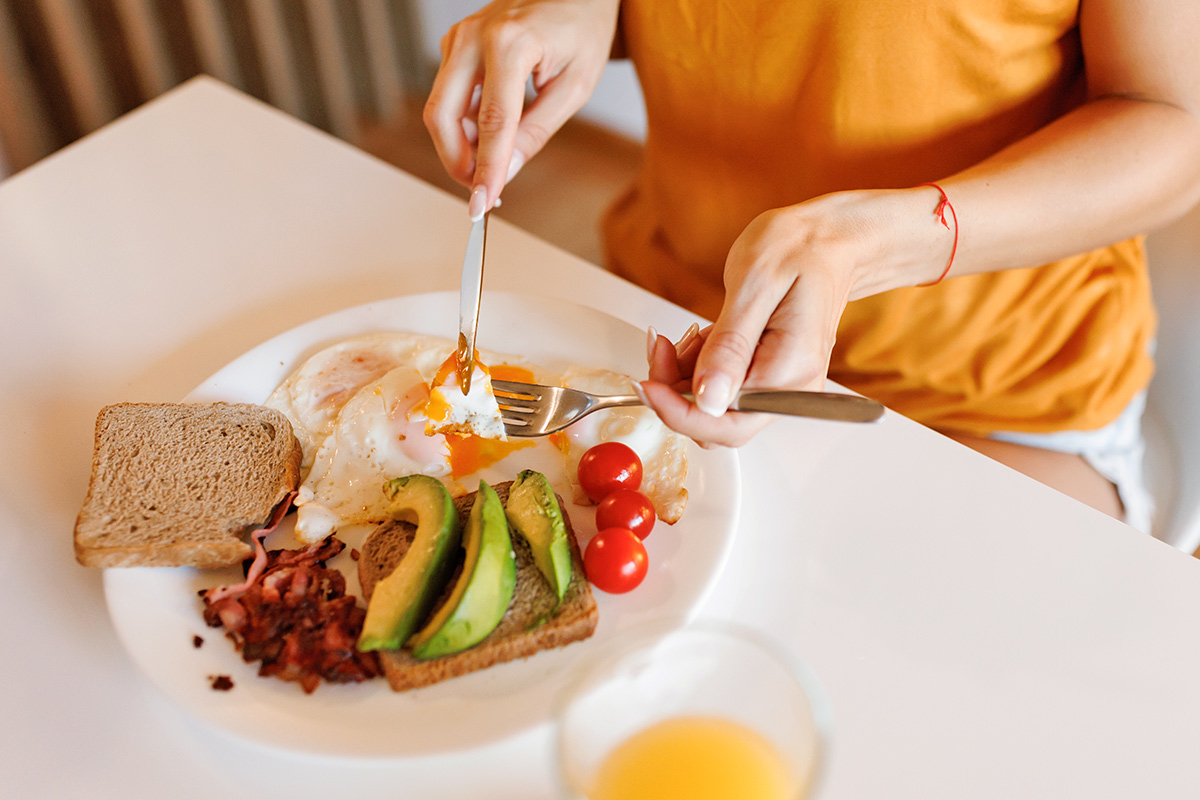
However, “we have no idea what these people ate for breakfast in this study. Just that they ate,” he adds. “What matters more is what you are eating in that first meal. A breakfast that is low in fat, moderate in protein, with a complex carb is a great combination.”
Featured Image Credit: © bojanstory—E+/Getty Images
More From Our Network
Better Report is part of Inbox Studio, an email-first media company. *Indicates a third-party property.







Kat Long is a freelance science journalist in the Washington, D.C. area. Previously, she was the science editor at Mental Floss and a digital editor at National Geographic. She now writes the Arctic Archives newsletter on Substack. Kat spends her free time birdwatching, road-tripping to historical sites and perusing old manuscripts at libraries.
This article is for general informational purposes only.
Affiliate Disclaimer Medical Disclaimer Financial Disclaimer