7 Places You’re Forgetting To Apply Sunscreen

All featured products and deals are selected independently and objectively by the author. Better Report may receive a share of sales via affiliate links in content.
You’re not great at applying sunscreen — in fact, almost no one is. “Multiple studies from around the world have shown that people apply, on average, 20% to 50% of the recommended amount of sunscreen,” says Dr. Samantha Schneider, a dermatologist and Mohs micrographic surgeon at the Nevada-based Pacific Crest Dermatology. “This means that the vast majority of people are not actually getting the SPF number that is written on the bottle.”
It also means there are probably areas on your body that you’re missing when you apply — and that’s a problem as the weather warms up and we spend more time in the sun’s ultraviolet rays. “Ultraviolet radiation … is considered a Group 1 carcinogen, which means it is cancer-causing in humans, just like cigarettes,” Dr. Schneider says.
The data paints a similar picture: According to the American Academy of Dermatology, skin cancer is the most common cancer in the U.S., and one in five Americans will develop it in their lifetime. Proper sunscreen application can help protect you. Read on to find out which areas of your body you’re forgetting when you apply, plus some tips and tricks for getting the full SPF coverage you need.
Areas You’re Missing When Applying Sunscreen
According to Dr. Schneider, one area where people do tend to use sunscreen is the face, though they may neglect the area around the eyes. “Sometimes it’s because sunscreen can be irritating around the eyes and other times I think it really is just because we forget,” she says. But the skin there is thin and particularly susceptible to UV damage, so it’s “important to extend your face sunscreen up underneath your eye and over your eyebrows.” There are a number of other areas where sunscreen may be forgotten, including the body parts below, which Dr. Schneider says are frequently missed:
- Ears
- Lips
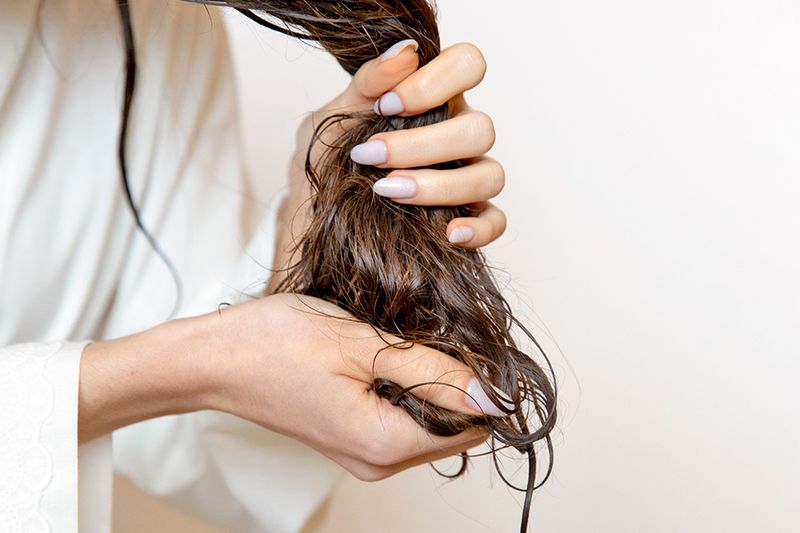
- Scalp
- Neck
- Backs of the hands
- Tops of the feet
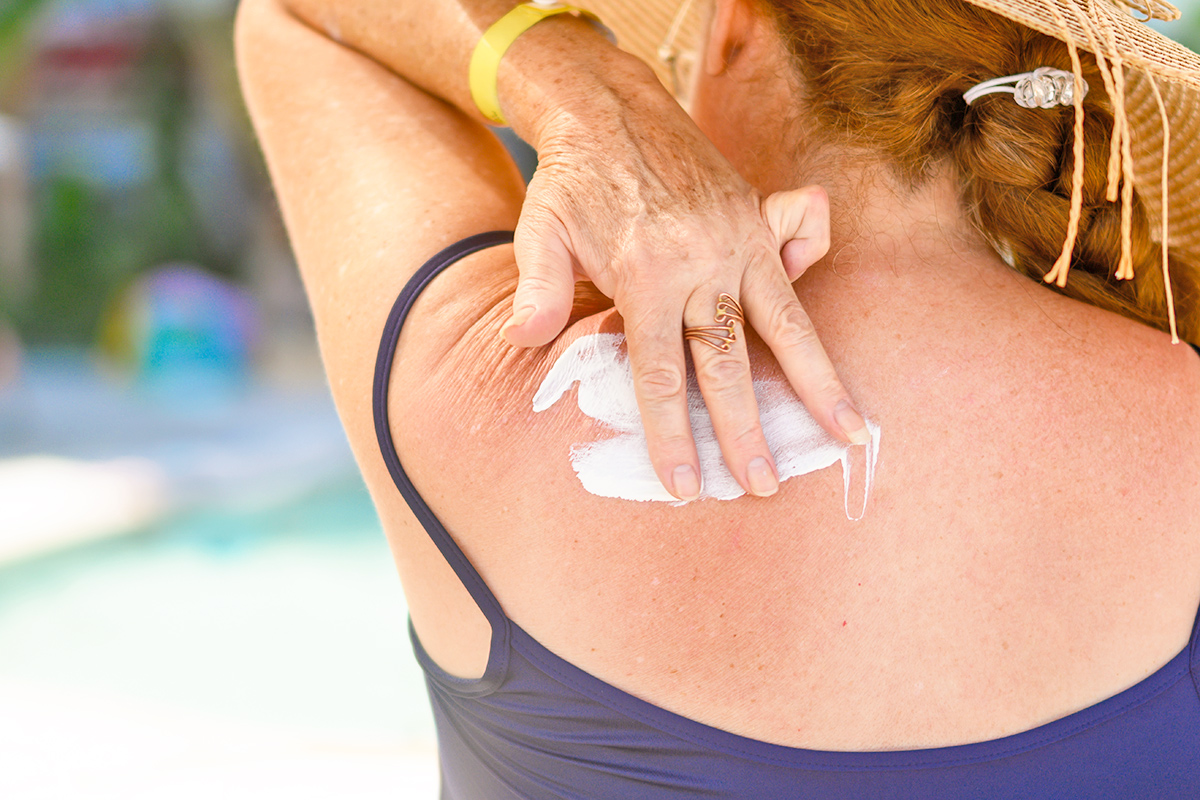
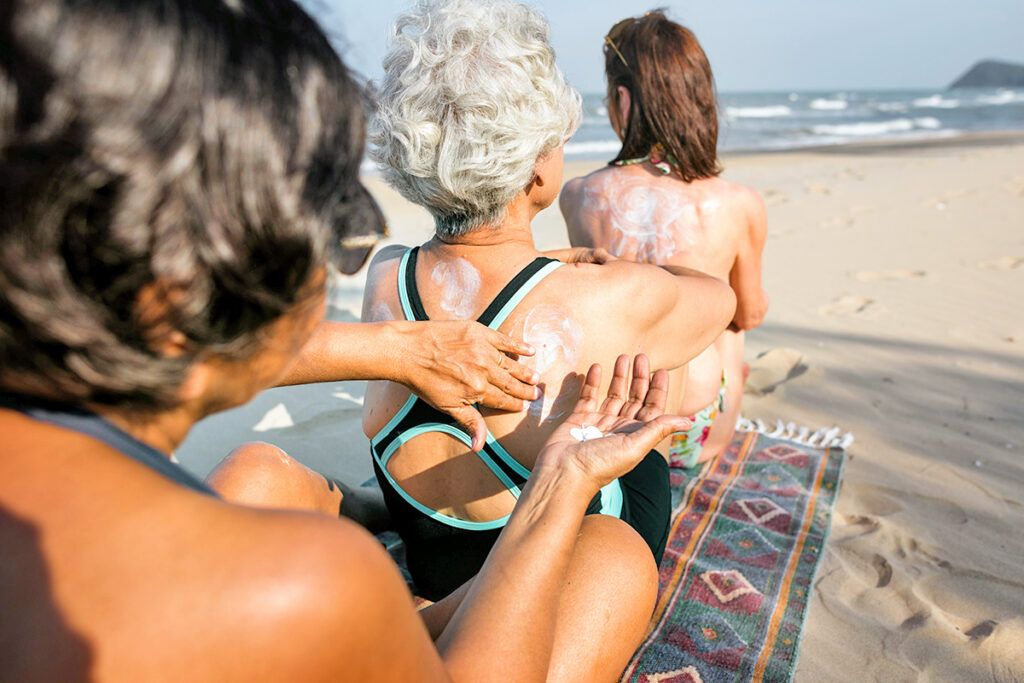
- The back (because it’s hard to reach)

Reader Favorites



Missing areas of your body can result in “wrinkles, dull skin, loss of collagen and elasticity, and brown spots,” but of course the most serious consequence of not properly applying sunscreen is skin cancer. Dr. Schneider frequently performs Mohs surgery, a procedure in which thin layers of the skin are removed until no cancer remains. “As a Mohs surgeon, I am removing skin cancer from ears, lips, and scalps weekly in my clinic,” she says, adding that she also sees clients every day with concerns about premature aging caused by decades of sun exposure without taking the proper precautions.
Application Tips and Tricks
The major issue that people need to overcome is that they’re applying half (or even less) of the amount used in a laboratory setting to give the rating on the bottle, according to Dr. Schneider. “The relationship between the number on the bottle and what protection you receive is not linear, but rather logarithmic,” she explains. “This means that when you apply half of the recommended amount, you are getting much less than half of the protection.”
If you’re only using foundation or moisturizer with SPF in it, you’re likely not getting enough protection, either. “Oftentimes, these are not broad-spectrum coverage — meaning they are not protecting against UVB and UVA — and most people are not putting on enough of their foundation or powder to actually get the coverage they think they are getting,” Dr. Schneider says.
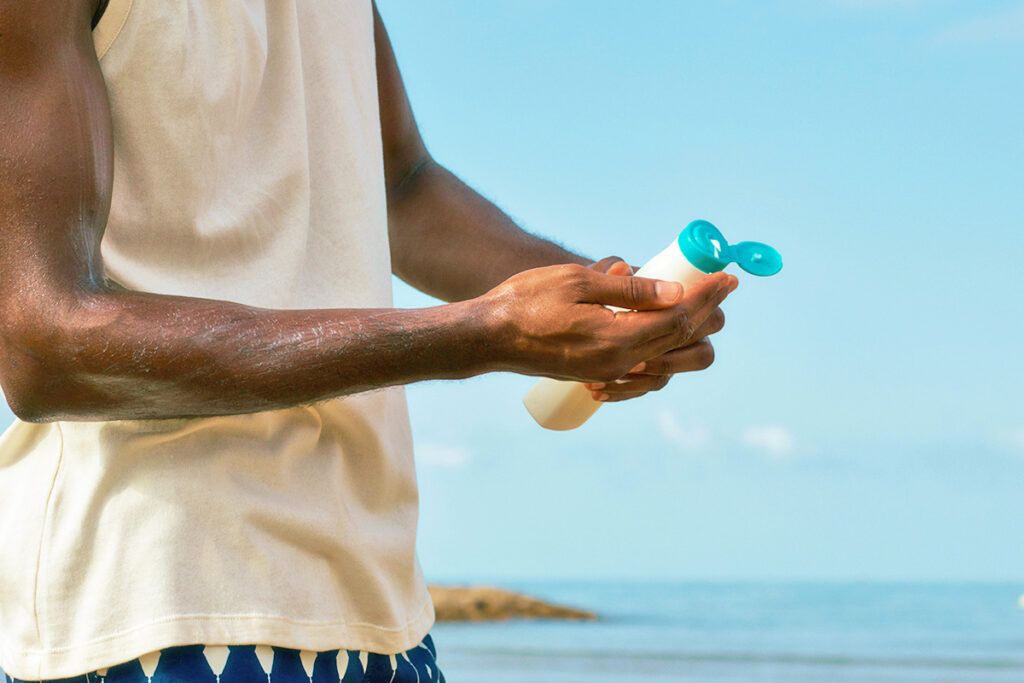
So how can you make sure you’re fully covered? The recommendation is to apply a shot glass of sunscreen total to the parts of your body that aren’t covered by clothing. “For most people, it would mean face, neck (including back of neck), ears, upper chest, arms, legs, hands, and tops of feet, if [they’re] wearing sandals,” Dr. Schneider says. She advises her patients to apply sunscreen in two layers to ensure they’re getting enough coverage. “When you apply a first round of sunscreen, let it soak in, and then apply another [layer], you more closely approach the recommended amount of sunscreen that the SPF number is based upon,” she says.
She layers two different sunscreens on her face: EltaMD UV Recovery has a green tint that evens out some of the redness in her skin, followed by ISDIN’S Eryfotona Ageless Tinted SPF, which also serves as her foundation.
You can also get specific products for different areas of your body. “I am a big fan of SPF for lips. This is a highly neglected area, and trust me, no one wants a skin cancer on their lips,” she says. “I really like EltaMD UV Lip Balm Broad Spectrum SPF 36 for adventures outdoors. And I love Prequel’s Lip Visor for daily use.” If sunscreen irritates the area around your eyes, Dr. Schneider recommends trying Colorescience 3-in-1 Total Eye. You can use a mineral brush with SPF powder for your scalp or to reapply on your face if you have makeup on; Dr. Schneider likes ISDIN’s Mineral Brush and Colorscience Sunforgettable.
To make sure you’re not missing anything, she recommends coming up with a method for applying your sunscreen. “Do it the same way each time,” she says. “Creating a habit makes it second nature so that you don’t forget anything.”

Other Things To Keep in Mind
Sunscreen should be worn every day. “I recommend daily SPF application on your face, neck, and back of hands because we get a surprising amount of exposure through windows and walking to and from buildings throughout the day,” Dr. Schneider says. Don’t forget to reapply every two hours, particularly if you’re spending a lot of time outdoors or are swimming and sweating. “Once in the morning does not give all day protection.”
Dr. Schneider also recommends packing a hat, a neck drape, and UPF clothing if you’re going to be outside for long periods of time: “Having alternative methods of protection with you for an ‘Uh oh, I think I might be burning’ moment can help save the day.” That said, not all UPF clothing is created equal. “The protection that you receive from clothing depends on the weave of the fabric,” she says. “A loosely crocheted pool cover-up is not going to provide the same sun protection as a tightly woven UPF50 sun hoodie.”
There are many different kinds of sunscreen, and it’s safe for you to use. “There is no evidence that, when used in the real world, [sunscreen] causes cancer or hormone disruption, but we know that UVR is a Grade 1 carcinogen and does cause cancer,” Dr. Schneider says. You may want to go for lotion over a spray, which “can be helpful, but they still do need to be rubbed in or you can get streaky coverage that leads to a sunburn.” Ultimately, she says, “The best sunscreen is the one that you are actually going to wear.”
Featured Image Credit: © Alejandro Franco Garcia—iStock/Getty Images
More From Our Network
Better Report is part of Inbox Studio, an email-first media company. *Indicates a third-party property.







Erin is a writer, editor, and content strategist living in the New York City area. Previously, she was the VP/Editor-in-Chief of MentalFloss.com and an editor at Popular Mechanics magazine. When she’s not working, Erin is hanging out with her cats, reading books from her never-ending TBR, traveling, karaoking, and making sourdough with her starter Stephen Sondheim.
This article is for general informational purposes only.
Affiliate Disclaimer Medical Disclaimer Financial Disclaimer