Skip to content
Better Report
  • Home
  • Health
  • Wealth
8 Low-Maintenance Plants That Thrive on Neglect
  • Search
  • Subscribe
  • Home
  • Health
  • Wealth
  • About
  • Privacy Policy
  • Terms of Use
  • Contact Us
  • SubscribeSubscribe
  • Search
Thank you for confirming your email! Welcome to the community.

Tag: Wealth

Is the Nickel Facing Extinction?

Wealth | Updated: June 2, 2026
Jennifer M. Wood
Author
Jennifer M. Wood has been writing about news, entertainment, culture, and travel for longer than she cares to admit. She lives just outside Philadelphia with her husband and an ever-growing menagerie of rescue pets.
Money in a jar
Better Report

“Keep the change” could soon sound like a quaint expression from a bygone era.

Seven months after the U.S. Mint officially retired the penny, following the secretary of the Treasury’s determination that the one-cent piece, which cost nearly 4 cents to produce, was “no longer necessary to meet the needs of the United States,” USA Today reports that the nickel could follow its copper-colored sibling down the road to obsolescence.

Advertisement
Advertisement

“The argument for getting rid of the nickel is that it costs more to produce — quite a bit more, actually — than its face value,” David Smith, an economist at Pepperdine University, told the outlet. 

When it comes to currency, being a literal money loser is a bad thing, as the penny learned the hard way. And in the case of the nickel, the annual losses are even greater. 

Coins being produced at the Denver Mint
Credit: © UCG/Getty Images

How Much Does It Cost To Make a Nickel?

The attack on our coinage seems to have begun in earnest following the U.S. Mint’s 2024 Annual Report, which included a breakdown of the true cost of making change. It concluded that the cost of making a single nickel was 13.78 cents — nearly three times the face value of the coin itself. 

Advertisement

With the government losing 8.78 cents on every nickel minted, the annual loss just to keep the coin in circulation was an estimated $85 million. And this is not a new problem: The 2024 report marked the 19th year in a row the nickel operated at a loss, fueling renewed calls to end its production.

Change in a cash register
Credit: © Ozgur Coskun—iStock/Getty Images

What Problems Could Arise From Killing the Nickel?

Eliminating the nickel isn’t as simple as just declaring it dead. As we’ve seen with the penny, there are some practical headaches that will likely arise for both businesses and consumers.

For example, without nickels or pennies, cash transactions will probably need to be rounded to the nearest 10 cents, which could result in higher prices that shoppers deem unfair. 

Recommended Articles

  • A Warning Sign for Heart Attack and Stroke Could Show Up on Your Face

  • 6 Holiday Scams To Watch Out For

  • Why Gift Cards Are Actually Terrible Gifts

  • The Strange Reason Why Time Feels Like It’s Moving Faster

Advertisement
Advertisement

Reader Favorites

  • Person washing part of a coffee machine

    18 Surprising Things You Should Never Put Down Your Drain

  • Woman brushing hair

    9 Surprising Signs You’re Aging

  • White car on the road

    The Best Cars for Resale Value, According to Auto Experts

In 2012, Mark Weller, executive director of Americans for Common Cents, who was advocating for the penny, argued in front of Congress that “in practice, price rounding cannot be fairly done.” While some economists have argued that the rounding will eventually even out, as some prices would likely be rounded down, Weller disagreed.

“The claim that rounding will have no appreciable effect on the consumer is predicated on the notion that there is an equal 10% probability of purchase prices ending in a particular digit,” he said. “In fact, evidence suggests that the equal probability assumption is false.”

Advertisement

On the opposite side of the argument, Wake Forest University economics professor Robert Whaples told Bankrate that his own research indicated “that the last digit in the cash register total is random, so there would be as much rounding down as there is rounding up — and the customer won’t be gouged, nor will there be an inflationary impact.”

Cash and a bill
Credit: © MargJohnsonVA—iStock/Getty Images

What Do Cash-Paying Consumers Think of the Idea?

Even if the economics behind eliminating the nickel appear increasingly difficult to ignore, Americans may still need some convincing. Currency has a way of inspiring emotional attachments that far outweigh its monetary value, particularly for older consumers who still rely on cash transactions.

Advertisement
Advertisement

There are also logistical concerns. Retailers, banks, transit systems, vending machine operators, and laundromats would all likely need to update equipment and pricing systems to accommodate a newly nickel-less world. While digital payments dominate everyday commercial transactions, millions of Americans still regularly rely on cash — meaning any rounding policy could disproportionately affect lower-income households.

That said, the same concerns were raised for years about the penny before the Treasury ultimately decided the coin had outlived its usefulness. More than two dozen other countries, including Canada, Australia, the United Kingdom, and Italy, have already phased out low-value coins and adopted cash-rounding systems with relatively little long-term disruption.

For now, the nickel remains safe jangling around in Americans’ pockets, or lodged somewhere between their sofa cushions. But with the cost of producing the coin continuing to climb, and cash itself becoming less central to everyday life, the pressure to retire another piece of U.S. currency is unlikely to disappear anytime soon.

Advertisement

Featured Image Credit: © Winslow Productions/Tetra Images/Getty Images

More From Our Network

Better Report is part of Inbox Studio, an email-first media company. *Indicates a third-party property.

Go Retro With This 1960s Fashion Quiz

Quiz Daily

Go Retro With This 1960s Fashion Quiz

True or False: Are You a Master of U.S. Geography?

Travel Quiz

True or False: Are You a Master of U.S. Geography?

5 Reasons You Can Be Denied Boarding an Airplane

Daily Passport

5 Reasons You Can Be Denied Boarding an Airplane

What Did People Do Before Eyeglasses?

History Facts

What Did People Do Before Eyeglasses?

How To Use a Balloon To Clean Up Dust

House Outlook

How To Use a Balloon To Clean Up Dust

11 Shopping Hacks Costco Members Should Know

FinanceBuzz*

11 Shopping Hacks Costco Members Should Know

Share this article

  • Share to Facebook
  • Share to Twitter
  • Copy Url
  • Share to Email
Jennifer M. Wood
Writer

Jennifer M. Wood has been writing about news, entertainment, culture, and travel for longer than she cares to admit. She lives just outside Philadelphia with her husband and an ever-growing menagerie of rescue pets.

This article is for general informational purposes only.
Affiliate Disclaimer Medical Disclaimer Financial Disclaimer

Updated: May 8, 2026
Posted In: Wealth
Hero Image Credit: Better Report
Advertisement

Related Articles

6 Holiday Scams To Watch Out For

7 min read

Why Gift Cards Are Actually Terrible Gifts

6 min read

How To Spot a Fake Amazon Review

7 min read

7 Things You Can Stop Buying To Save Money

6 min read

13 Stocking Stuffers That Are Actually Useful

8 min read
Advertisement

6 Things You Didn’t Know Lemons Could Do

Home | Updated: June 1, 2026
Erin Scottberg
Author
Erin Scottberg is a Brooklyn-based writer, garden designer, and houseplant expert — and the founder of Full Sun Studio (fullsun.studio), a garden design and plant consulting studio in New York City. She holds an Urban Horticulture Certificate from Brooklyn Botanic Garden, an NYC Street Tree Pruner License, and an NYC Master Composter Certification, and spent three years as Head of Content and Education at The Sill. When she's not working, you can find her creating in her textile studio, running craft nights in her neighborhood, or hanging with her rescue pup, Sunny. She's an ambitious DIYer, avid composter, and has never been able to walk by a thirft store without taking a look.
Bowl of lemons
Better Report

I buy at least one lemon any time I go to the grocery store. Why? Lemons are the kitchen’s biggest overachiever: They’ll zest up your pasta (or even a serving of frozen veggies), make your water feel fancy, and add a bright flavor to quick salad dressing. But they also have a ton of uses beyond culinary applications — a lemon can clean your microwave, help you make pancakes, and save you a trip to the nail salon. Here are six surprising reasons to always keep a lemon on hand. 

Lemons in microwave
Credit: © IntelWond/stock.adobe.com

Clean Your Microwave 

You know that baked-on splatter you ignore every time you open your microwave? Here’s the laziest possible fix: Squeeze lemon juice into a microwave-safe bowl of water, toss the halves in, and nuke it all for three minutes. Then let it sit for five minutes longer while the lemony steam does the heavy lifting. The citric acid acts as a natural degreaser and antibacterial agent, so when you finally crack open the microwave, all that crusty gunk should wipe right off. 

Advertisement
Advertisement
Cat in garden
Credit: © Osman Minaz/Pexels.com

Keep Neighborhood Cats Out of Your Garden

If you’ve ever found a mysterious “deposit” in your flower bed, you know the particular frustration of having a curious kitty in your neighborhood. Thankfully, there’s an easy, natural solution to this problem. Cats hate the smell of citrus — their noses are about 40 times more sensitive than ours, and that makes the scent of lemons (as well as other citrus fruits, such as oranges and limes) very unappealing. To keep the local felines from treating your garden like a litter box, scatter citrus peels around the edges. The catch: Peels have to be fresh (dried ones aren’t a deterrent), so you’ll need to replace them as they lose their scent. 

Cracked heels
Credit: © Pakawadee Wongjinda—iStock/Getty Images

Make a DIY Foot Peel With Aspirin

This sounds kind of wild, but it’s dermatologist-approved. To keep your feet in shape during sandal season, simply crush a few aspirin tablets into a powder and combine with freshly squeezed lemon juice and water to form a paste. Apply to cracked heels, wrap them in plastic and slip on some socks, and leave on up to an hour (but make sure to rinse immediately if it stings!). Finally, moisturize. The mixture is an acidic exfoliant that helps to loosen and dissolve dead skin — aspirin contributes aminosalicylic acid (which is related to the salicylic acid in acne products), while lemon juice amplifies the effect. 

Recommended Articles

  • A Warning Sign for Heart Attack and Stroke Could Show Up on Your Face

  • 6 Holiday Scams To Watch Out For

  • Why Gift Cards Are Actually Terrible Gifts

  • The Strange Reason Why Time Feels Like It’s Moving Faster

Advertisement
Advertisement

Reader Favorites

  • Person washing part of a coffee machine

    18 Surprising Things You Should Never Put Down Your Drain

  • Woman brushing hair

    9 Surprising Signs You’re Aging

  • White car on the road

    The Best Cars for Resale Value, According to Auto Experts

Pancakes
Credit: © Dazedream/Unsplash.com

Fake Buttermilk in a Pinch

Imagine: You’re three ingredients deep into a pancake recipe and realize you don’t have buttermilk. Save your breakfast by adding a tablespoon of fresh lemon juice to a cup of whole or 2% milk or heavy cream, let it sit for five to 10 minutes to thicken, and stir before using. It won’t be identical to the real thing, but it’ll do the job in pancakes, muffins, or cakes — especially when buttermilk isn’t the star flavor. 

Advertisement
Advertisement
Wooden cutting board
Credit: © Emilija Manevska—Moment/Getty Images

Scrub Your Cutting Board Clean

Wooden cutting boards are harder to sanitize than plastic ones because you can’t throw them in the dishwasher. Soap and hot water are usually sufficient to clean them, but if you want to give your wooden cutting board a deep clean, sprinkle the surface of the cutting board with some salt, cut a lemon in half, and start scrubbing. The salt acts as an abrasive and the lemon juice lifts stains and eliminates odors, making the board smell better than it has in years. Let the salty paste sit for five minutes, remove it with a bench scraper, and rinse the board well. 

Advertisement
Advertisement
Weeds in pavement
Credit: © Douglas Sacha—Moment/Getty Images

Kill Weeds (Kind Of)

Lemon juice is acidic enough to damage and kill small weeds, making it a nontoxic alternative to herbicides. That said, getting results from this hack requires a lot of lemon juice, and it will work only on young, small weeds with direct sun exposure. You’ll probably see the most success on gravel driveways or cracks between pavers — places where you can apply lemon juice liberally without worrying about affecting the plants you want to keep around. 

Feature image credit: © WJ Y/Pexels.com

More From Our Network

Better Report is part of Inbox Studio, an email-first media company. *Indicates a third-party property.

Go Retro With This 1960s Fashion Quiz

Quiz Daily

Go Retro With This 1960s Fashion Quiz

True or False: Are You a Master of U.S. Geography?

Travel Quiz

True or False: Are You a Master of U.S. Geography?

5 Reasons You Can Be Denied Boarding an Airplane

Daily Passport

5 Reasons You Can Be Denied Boarding an Airplane

What Did People Do Before Eyeglasses?

History Facts

What Did People Do Before Eyeglasses?

How To Use a Balloon To Clean Up Dust

House Outlook

How To Use a Balloon To Clean Up Dust

11 Shopping Hacks Costco Members Should Know

FinanceBuzz*

11 Shopping Hacks Costco Members Should Know

Share this article

  • Share to Facebook
  • Share to Twitter
  • Copy Url
  • Share to Email
Erin Scottberg
Writer

Erin Scottberg is a Brooklyn-based writer, garden designer, and houseplant expert — and the founder of Full Sun Studio (fullsun.studio), a garden design and plant consulting studio in New York City. She holds an Urban Horticulture Certificate from Brooklyn Botanic Garden, an NYC Street Tree Pruner License, and an NYC Master Composter Certification, and spent three years as Head of Content and Education at The Sill. When she's not working, you can find her creating in her textile studio, running craft nights in her neighborhood, or hanging with her rescue pup, Sunny. She's an ambitious DIYer, avid composter, and has never been able to walk by a thirft store without taking a look.

This article is for general informational purposes only.
Affiliate Disclaimer Medical Disclaimer Financial Disclaimer

Updated: May 27, 2026
Posted In: Home
Hero Image Credit: Better Report
Advertisement

Related Articles

The Most Dangerous Things You Do With Your Christmas Tree

4 min read

12 Foods You Shouldn’t Store Together

6 min read

17 Home Safety Gifts Your Family Actually Needs

10 min read

Should You Refrigerate Peanut Butter?

6 min read

The Most Popular Car Colors in the U.S.

4 min read
Advertisement

Should You Refrigerate Tomatoes?

Sponsored Content
Home | Updated: May 21, 2026
Tomatoes in a fridge
Better Report

The beginning of summer is a glorious time at the farmers market. Not only is the temperature excellent (not too hot yet) for an outdoor shopping day, but the produce is at the top of its game — especially the tomatoes. I went from a tomato skeptic to a tomato lover when I got the best ones from my local farmers market and treated them properly.  

Whether you’re making an elaborate bruschetta or just eating tomato slices on their own, you want to make sure they’re at their best. And while it may feel like the right move to put them in the refrigerator, where you should store your tomatoes depends on a few factors. Let’s break it down. 

Tomatoes on the counter
Credit: © Gunnar Ridderström/Unsplash.com

The Case for the Counter 

To figure out how to best store your tomatoes, you’ll want to determine how ripe they are and also when you plan to use them. 

The refrigerator is a useful tool for extending the life of many foods, but for the most part, it’s one of the worst places for fresh tomatoes. In the fridge, tomatoes become mealy and lose flavor, becoming sour. This is part of why farmers market tomatoes are preferable to those you buy at the supermarket: They haven’t been chilled for transport and therefore haven’t lost taste and texture.

Advertisement
Advertisement

If you’re planning to make a meal with your tomatoes quickly, or if they need time to ripen, you can keep them in a dry area of the counter, stem-down — this prevents bacteria from entering the fruit and keeps them juicy. You can also put a little tape over the stem to keep them fresh. They should be out of direct sunlight and, ideally, at a temperature between 60 and 70 degrees Fahrenheit. Counter storage works for larger tomatoes and for smaller grape or cherry tomatoes as well, even though they’re in a container.

Advertisement

Fresh tomatoes last two to five days on the counter. Check them daily to ensure they don’t go bad — you’ll know your tomato is ripe when it’s uniform in color and tender to the touch, whereas an overripe tomato will be soft and possibly start leaking. 

Recommended Articles

  • A Warning Sign for Heart Attack and Stroke Could Show Up on Your Face

  • 6 Holiday Scams To Watch Out For

  • Why Gift Cards Are Actually Terrible Gifts

  • The Strange Reason Why Time Feels Like It’s Moving Faster

Advertisement
Advertisement

Reader Favorites

  • Person washing part of a coffee machine

    18 Surprising Things You Should Never Put Down Your Drain

  • Woman brushing hair

    9 Surprising Signs You’re Aging

  • White car on the road

    The Best Cars for Resale Value, According to Auto Experts

Cut tomatoes on a cutting board
Credit: © Peter Dyllong/Pexels.com

When It’s OK To Put Tomatoes in the Fridge

There are some scenarios where you should put your tomatoes in the fridge. Any cut tomatoes that aren’t used fully, for example, should be stored in the fridge. Cover them with cling wrap so they don’t dry out, then place them in an airtight container before putting them in the refrigerator. They’ll last a day or two and stay safe from bacterial growth. 

Advertisement
Advertisement

Ripe tomatoes that are about to become overripe can also go in the fridge, where they may last for up to two weeks. That said, they likely won’t taste as good when you take them back out, so experts advise using them only in cooked dishes.

Tomato soup
Credit: © Curated Lifestyle/Unsplash.com 

Getting the Most Out of Your Tomatoes

If you have tomatoes that are ripe but you don’t want to eat them yet (or you’ve had them in the fridge), you can make a red sauce, turn them into soup, or freeze them whole and use them later.  Don’t just throw them in the freezer, though — take the time to blanch the tomatoes. Drop them into boiling water for 30 seconds, then put them in dated freezer bags. When you unfreeze these tomatoes later, it’s best to use them for recipes that require cooking. 

Advertisement
Advertisement

As we get ready for peak summer produce season, consider the refrigerator the last resort, instead of the first step. Your tomatoes will thank you. 

Featured Image Credit: © Getty Images/Unsplash.com

More From Our Network

Better Report is part of Inbox Studio, an email-first media company. *Indicates a third-party property.

Go Retro With This 1960s Fashion Quiz

Quiz Daily

Go Retro With This 1960s Fashion Quiz

True or False: Are You a Master of U.S. Geography?

Travel Quiz

True or False: Are You a Master of U.S. Geography?

5 Reasons You Can Be Denied Boarding an Airplane

Daily Passport

5 Reasons You Can Be Denied Boarding an Airplane

What Did People Do Before Eyeglasses?

History Facts

What Did People Do Before Eyeglasses?

How To Use a Balloon To Clean Up Dust

House Outlook

How To Use a Balloon To Clean Up Dust

11 Shopping Hacks Costco Members Should Know

FinanceBuzz*

11 Shopping Hacks Costco Members Should Know

Share this article

  • Share to Facebook
  • Share to Twitter
  • Copy Url
  • Share to Email
Sponsored Content

This article is for general informational purposes only.
Affiliate Disclaimer Medical Disclaimer Financial Disclaimer

Updated:
Posted In: Home
Hero Image Credit: Better Report
Advertisement

Related Articles

The Most Dangerous Things You Do With Your Christmas Tree

4 min read

12 Foods You Shouldn’t Store Together

6 min read

17 Home Safety Gifts Your Family Actually Needs

10 min read

Should You Refrigerate Peanut Butter?

6 min read

The Most Popular Car Colors in the U.S.

4 min read
Advertisement

What the Tooth Fairy’s Paying in 2026

Wealth | Updated: April 1, 2026
Bennett Kleinman
Author
Bennett Kleinman is a New York City-based staff writer for Inbox Studio. He is also a freelance comedy writer, devoted New York Yankees and New Jersey Devils fan, and thinks plain seltzer is the best drink ever invented.
Child putting tooth under pillow
Better Report

Certain statistics are good indicators of how the overall economy is performing, such as inflation and the unemployment rate. But there’s an unexpected metric that provides an equally good indication of the current state of the economy: the Tooth Fairy.

Advertisement
Advertisement

It’s long been a tradition in the U.S. and other countries around the world for the Tooth Fairy (wink wink) to leave cash when a child loses a baby tooth. But according to Delta Dental, which comprises the largest group of dental insurance companies in the U.S., the average amount of money has risen sharply over time. The company has released an annual Tooth Fairy Index (TFI) since 1998, and it shows parallel growth to the S&P 500 stock index. Here’s a look at what the Tooth Fairy is paying in 2026.

Child missing tooth holding a dollar bill
Credit: © jaclynwr/iStock

A Continued Rise

Before diving into the numbers, a quick look at the methodology: Delta Dental surveyed 1,000 parents nationwide with children ages 6 through 12, conducting the poll between January 5 and 16 of 2026. The results have a margin of error of +/- 3%. 

Now let’s get to the numbers: When the first Tooth Fairy Index was conducted in 1998, the average amount paid per tooth was $1.30, which equates to more than $2.50 when adjusted for inflation. But the current average sits at $5.84, denoting a 17% increase from last year’s average of $5.01. This marks the first time since 2023 that the TFI has gone up, as 2024 and 2025 each saw a slight decline. The current $5.84 average also marks a 349% spike since the TFI began.

Recommended Articles

  • A Warning Sign for Heart Attack and Stroke Could Show Up on Your Face

  • 6 Holiday Scams To Watch Out For

  • Why Gift Cards Are Actually Terrible Gifts

  • The Strange Reason Why Time Feels Like It’s Moving Faster

Advertisement
Advertisement

Reader Favorites

  • Person washing part of a coffee machine

    18 Surprising Things You Should Never Put Down Your Drain

  • Woman brushing hair

    9 Surprising Signs You’re Aging

  • White car on the road

    The Best Cars for Resale Value, According to Auto Experts

The 17% increase in the TFI from 2025 to 2026 is almost perfectly in line with the S&P 500, which increased 16% over that same time period. The S&P 500 has also jumped 480.93% since 1998 — the year the TFI began. While the percentage may be higher than the TFI’s 349%, it indicates parallel growth during that same time period. (But that’s not to say it’s all growth all the time: The S&P 500 has been trending downward in recent weeks.) 

Delta Dental provided some additional insights, including the fact that parents — ahem, sorry, the Tooth Fairy — reported leaving more money when a child loses their first tooth. The stats show that a first tooth is worth 23% more than average, or around $7.17. Some 38% of parents who were surveyed said they left extra cash to celebrate that milestone before dropping the amount for any teeth lost going forward. And the Tooth Fairy doesn’t leave cash for everyone: 32% of kids got gifts instead.

Advertisement
Dollar bill on a bed
Credit: © yanadjan/stock.adobe.com

The Tooth Fairy’s Rates by Region

The average amount left for a tooth also varies depending on where the Tooth Fairy visits. 

The Northeast has the highest total of any region at $6.45, which is a 41% jump from 2025. In the West, lost teeth earn a $5.99 reward — a 5% increase year-over-year. 

Advertisement
Advertisement

Next up is the South, which held the top spot in 2025. Despite a 3% increase from 2025 to 2026, it now holds the third ranking at $5.89. Last on the list is the Midwest, where kids earn $5.27 per tooth, 52% more than in 2025.


But the Tooth Fairy isn’t merely an American phenomenon — other countries reward kids for lost teeth as well. In Canada, the average is $8.00 CAD ($5.78 USD); in England it’s 4.34 pounds ($5.78 USD); Spain and Ireland leave 4.96 euros ($5.72 USD) per tooth; and in Japan, each tooth is worth 904 yen ($5.66 USD).

Advertisement
Advertisement

Featured Image Credit: © undefined undefined/iStock

More From Our Network

Better Report is part of Inbox Studio, an email-first media company. *Indicates a third-party property.

Go Retro With This 1960s Fashion Quiz

Quiz Daily

Go Retro With This 1960s Fashion Quiz

True or False: Are You a Master of U.S. Geography?

Travel Quiz

True or False: Are You a Master of U.S. Geography?

5 Reasons You Can Be Denied Boarding an Airplane

Daily Passport

5 Reasons You Can Be Denied Boarding an Airplane

What Did People Do Before Eyeglasses?

History Facts

What Did People Do Before Eyeglasses?

How To Use a Balloon To Clean Up Dust

House Outlook

How To Use a Balloon To Clean Up Dust

11 Shopping Hacks Costco Members Should Know

FinanceBuzz*

11 Shopping Hacks Costco Members Should Know

Share this article

  • Share to Facebook
  • Share to Twitter
  • Copy Url
  • Share to Email
Bennett Kleinman
Staff Writer

Bennett Kleinman is a New York City-based staff writer for Inbox Studio. He is also a freelance comedy writer, devoted New York Yankees and New Jersey Devils fan, and thinks plain seltzer is the best drink ever invented.

This article is for general informational purposes only.
Affiliate Disclaimer Medical Disclaimer Financial Disclaimer

Updated: July 20, 2023
Posted In: Wealth
Hero Image Credit: Better Report
Advertisement

Related Articles

6 Holiday Scams To Watch Out For

7 min read

Why Gift Cards Are Actually Terrible Gifts

6 min read

How To Spot a Fake Amazon Review

7 min read

7 Things You Can Stop Buying To Save Money

6 min read

13 Stocking Stuffers That Are Actually Useful

8 min read
Advertisement

Why Having a Will Isn’t the Same as Estate Planning

Sponsored By
Wealth | Updated: February 25, 2026
Aleks Kang
Author
Aleks Kang is one half of the Britannica Group's Content Studio, a hub for high-quality editorial, branded, and commerce content across our newsletters and websites.
Better Report

You finally sit down to write your will — something you’ve meant to do for years. You name an executor and outline who should get what. It feels like a responsible milestone, maybe even a relief. Estate, planned. That moment can feel like the finish line. It isn’t, though.

A Will Is Just the Start

A will is one of the clearest ways to document your wishes. It lets you name someone to manage your estate and spell out who should receive specific assets, but it doesn’t necessarily simplify what comes next. Even with a will in place, your estate may still go through probate, the court process that oversees how assets are distributed. 

But without a will or trust at all, state law may determine who receives your estate. So, yes, having a will is important, but it’s just one part of a full plan.

Other Tools for Estate Planning

Certain investment accounts, such as IRAs or transfer-on-death (TOD) accounts, let you name beneficiaries directly. These designations are often set and forgotten, but they play a major role in what actually happens with your assets. You can name both primary and contingent beneficiaries, and unless you update them, those choices typically stay in place.

Advertisement

Living trusts are another option. These written agreements let you name someone to manage your assets and specify who will receive them. Unlike a will, a living trust can also help if you become unable to manage your finances during your lifetime. Someone you trust could step in and handle things on your behalf, without waiting for a court’s permission.

For some investors, beneficiary designations and trusts don’t replace a will; they work alongside it. Each tool serves a different purpose, and understanding where they overlap can help clarify how a complete plan fits together.

It Only Works If the Money Adds Up

Estate planning isn’t just about completing the proper paperwork. Your investment strategy is equally important. If you aim to leave a specific amount behind, your portfolio must support that objective.

If you’re leaving assets to younger family members or organizations, there’s a chance they’ll need to rely on that money for years to come. That calls for a portfolio built for long-term growth. A plan on paper only works if the investment strategy is designed to execute it.

Advertisement

How to Turn Plans Into Peace of Mind

The process is complicated. That’s the simple truth, but doing the work to organize your estate while you’re still living ensures your plan will be properly executed. A will is an important starting point, but it may not cover everything on its own. Beneficiary designations, trusts, and investment decisions all shape what happens down the line. 

For some people, that means thinking through how a spouse will access shared assets. For others, it’s about lessening the burden for adult children or fulfilling a charitable goal. Everyone’s reasons are different, but the value of a clear, connected plan is the same.

If you want a better sense of how these tools work together and what to consider next, Fisher Investments’ Investor’s Guide to Estate Planning can help.

Download Fisher Investments’ Investor’s Guide to Estate Planning to start planning your estate.  

Advertisement

This story was paid for by an advertiser. Better Report’s editorial staff was not involved in the creation of this content.

This story was paid for by an advertiser. Better Report's editorial staff was not involved in the creation of this content.

Recommended Articles

  • A Warning Sign for Heart Attack and Stroke Could Show Up on Your Face

  • 6 Holiday Scams To Watch Out For

  • Why Gift Cards Are Actually Terrible Gifts

  • The Strange Reason Why Time Feels Like It’s Moving Faster

Advertisement
Advertisement

Related Articles

6 Holiday Scams To Watch Out For

7 min read

Why Gift Cards Are Actually Terrible Gifts

6 min read

How To Spot a Fake Amazon Review

7 min read

7 Things You Can Stop Buying To Save Money

6 min read

13 Stocking Stuffers That Are Actually Useful

8 min read
Advertisement

What the 0.1% Aren’t Telling the Rest of Us About Retirement

Sponsored By
Sponsored Content
Wealth | Updated: December 12, 2025
Better Report

This story was paid for by an advertiser. Better Report’s editorial staff was not involved in the creation of this content.

Most Americans enter retirement hoping their savings, investment decisions, and timing align to support their long-term goals — keyword: hoping. For the top 0.1% of wealth holders, though, the reality looks different. Their portfolios may be larger, but the distinction isn’t only about income. They’re in the top 0.1% of planners, tax managers, and decision makers. 

Federal Reserve data on household wealth distribution shows the share of the nation’s assets this small group holds. The numbers are startling, but they didn’t shift overnight. The data reflect habits formed long before retirement, including how these households manage taxes and coordinate different types of accounts.

How the Ultra-Affluent Approach Taxes

For the most affluent retirees, tax planning isn’t a once-a-year event. It’s something they add to their long-term strategy, especially when it comes to Required Minimum Distributions (RMDs), capital gains, and changes in taxable income. Instead of waiting until distributions are unavoidable, they may consider how taking money earlier or adjusting the timing of gains might help manage taxes over several years. A key part of the strategy is understanding how different types of investment income are taxed.

Advertisement

“Capital gains have a much lower tax rate than earned income, interest, or dividends. And therefore are advantageous in that regard, relative to interest and dividends, with a higher total return,” Ken Fisher, founder and executive chairman at Fisher Investments, said.

Rather than focusing on minimizing their tax implication in a single year, they adapt their strategy to keep their withdrawal plan steady and sustainable.

They Coordinate Their Withdrawals Across Multiple Accounts

Affluent retirees often coordinate their withdrawals across multiple account types. Traditional IRAs, Roth accounts, brokerage assets, and appreciated holdings each play a role. They’re used in combination to support post-work income needs and manage tax bills across different stages of retirement. A long-term mindset often guides those decisions, especially when investors are balancing different assets and timelines.

“Stocks are inherently volatile, at least in the short term,” Aaron Anderson, senior vice president of research at Fisher Investments, said. “They become much less so over the long term — meaning the further out you go, the longer your time horizon, the more consistent stock returns become.”

Advertisement

This type of coordination can help keep taxable events predictable, whether someone is drawing down tax-deferred savings, using Roth accounts later for flexibility, or handling unexpected income changes.

They Take Planning Seriously

Even with planning tools available, many Americans are unsure how far their savings will stretch. A Pew Research Center survey found that roughly four in 10 Americans don’t feel confident they will have enough money to last their entire retirement. That uncertainty stands in contrast to the longer-range planning affluent households do. Though an early start lets you take advantage of compound interest, planning at any stage makes retirement feel more attainable. The gap between where wealth is concentrated and how people feel about their own retirement shows how much planning shapes the experience.

They Know When to Ask an Expert

Few households sit anywhere near the top 0.1% in wealth, a group whose share of national assets matches that of the bottom 50%, but the way those investors plan their taxes and sequence their withdrawals can still serve as a playbook for the other 99.9% of retirees. Many affluent households trust professional advisors who help them take a longer-term view of taxes and make decisions spanning decades. Fisher Investments offers these same resources to everyday investors, explaining these concepts (and others) in more depth.

Read Fisher Investments’ Tax-Efficient Wealth Management for Affluent Investors guide to get additional insights into tax-smart planning.

Advertisement

Feature Image Credit: Jordan Siemens / Getty Images

This story was paid for by an advertiser. Better Report's editorial staff was not involved in the creation of this content.

Recommended Articles

  • A Warning Sign for Heart Attack and Stroke Could Show Up on Your Face

  • 6 Holiday Scams To Watch Out For

  • Why Gift Cards Are Actually Terrible Gifts

  • The Strange Reason Why Time Feels Like It’s Moving Faster

Advertisement
Advertisement

Related Articles

6 Holiday Scams To Watch Out For

7 min read

Why Gift Cards Are Actually Terrible Gifts

6 min read

How To Spot a Fake Amazon Review

7 min read

7 Things You Can Stop Buying To Save Money

6 min read

13 Stocking Stuffers That Are Actually Useful

8 min read
Advertisement

0.1% of People Retire With This Much Money. Will You?

Sponsored By
Sponsored Content
Wealth | Updated: November 18, 2026
Better Report

This story was paid for by an advertiser. No members of Better Report’s editorial staff were involved in the creation of this content.

For retirees, a million dollars has always seemed like a solid goal. $1 million puts your mind at ease. Without doing the math to back into an annual salary, the sum should be enough to keep you afloat (and then some) through retirement, allowing you to do largely what you want and live where you please, enjoying your golden years to the fullest.

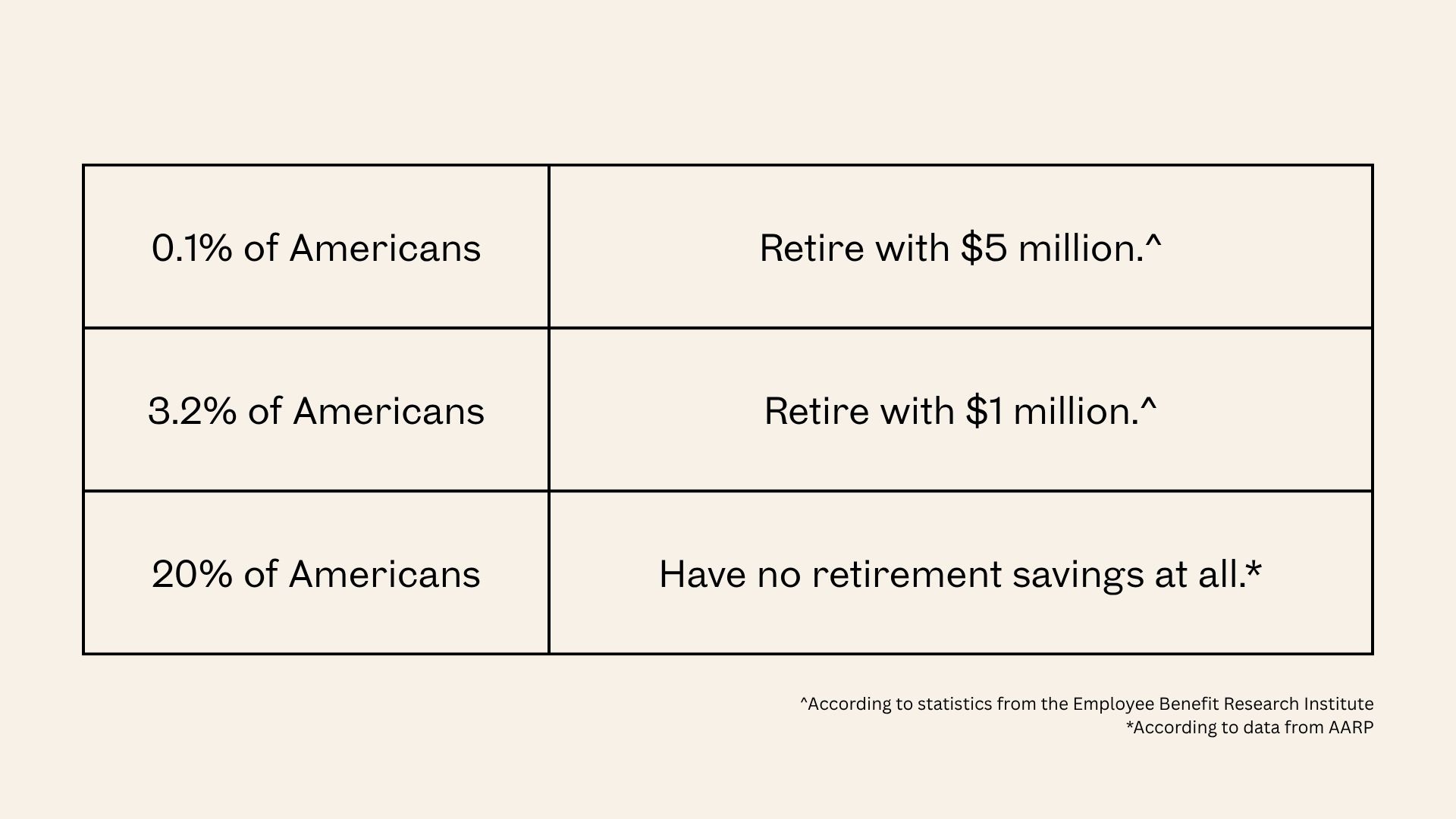
When you’re saving toward retirement, $1 million seems like an attainable plateau, too — somewhere you should reach, if all goes to plan. Though other surveys put that number closer to $4 million to be safe, a million is a commendable financial milestone that most will never reach. According to data from the Employee Benefit Research Institute’s analysis of the Federal Reserve’s Survey of Consumer Finances, just over 3% of retirees reach the $1 million milestone. 0.1% of them get to the $5 million mark. That means, in reality, most Americans are retiring with much less. Some have no savings at all, and, in turn, no investment income either. 

That means reaching either of the aforementioned financial milestones is an incredible achievement. At that point, it’s more than a nest egg; it’s an estate — something that puts you, and your family, at a financial advantage for generations, potentially. But it comes with new challenges, which require you to work smartly to protect what you’ve built. When your assets grow, so do your tax considerations — and even minor missteps can cost you more than you think.

As such, it’s wise to seek out the most tax-efficient ways to manage your wealth. From optimizing your investment strategy to planning when and how to draw from your account, a tax-smart approach can make the difference between maintaining your wealth and watching it erode.

Advertisement

Fisher Investments’ free guide, Tax-Efficient Wealth Management for Affluent Investors (for those who have $5 million or more), breaks it all down. It offers forward-looking advice to strengthen and optimize your portfolio, along with clear, actionable tax management techniques for retirement. Inside, you’ll find strategies that affluent investors use to stay a step ahead — whether that’s timing capital gains, structuring income for lower tax exposure, or making smarter charitable and estate planning decisions.

Download Tax-Efficient Wealth Management for Affluent Investors today.

This story was paid for by an advertiser. Better Report's editorial staff was not involved in the creation of this content.

Recommended Articles

  • A Warning Sign for Heart Attack and Stroke Could Show Up on Your Face

  • 6 Holiday Scams To Watch Out For

  • Why Gift Cards Are Actually Terrible Gifts

  • The Strange Reason Why Time Feels Like It’s Moving Faster

Advertisement
Advertisement

Related Articles

6 Holiday Scams To Watch Out For

7 min read

Why Gift Cards Are Actually Terrible Gifts

6 min read

How To Spot a Fake Amazon Review

7 min read

7 Things You Can Stop Buying To Save Money

6 min read

13 Stocking Stuffers That Are Actually Useful

8 min read
Advertisement

You Can Still Make Money During Retirement. Here’s How

Sponsored By
evan
Wealth | Updated: November 18, 2026
Puzzled worried serious elderly lady accountant with gray hair working from home, examining pay check sitting at kitchen table at home, counting expanses and income. Grandma holding utility bill
Better Report

This story was paid for by an advertiser. No members of Better Report’s editorial staff were involved in the creation of this content.

Retirement is supposed to be a reward, an opportunity to do whatever you want, whenever you want — within reason, of course. Sleeping in, booking trips, or finally trying the hobbies, no matter how esoteric or mundane, you’ve been meaning to try. Birding? Sounds great. Baking? Delicious. You can try these without worrying about interfering with your work schedule, meaning they can, if you so desire, become your entire personality. 

Though work is finally a thing of the past for you, money questions don’t magically disappear once your commute does. Nearly half of retirees — 45% to be exact — risk running out of savings, and that’s counting those who invested carefully and diversified their portfolios. The good news? You don’t need a job to keep making money. With the right income streams, your nest egg can keep generating cash while you focus on living your life — and learning to bake county-fair-quality pies.

Like pie, those streams come in many flavors: Dividend-paying stocks deliver regular cash payments. Bonds hand you coupons you can actually spend. Combining a few approaches yields a mix of growth and stability, which means it’s wise to explore more than just stocks and bonds. There are real estate investment trusts (REITs), master limited partnerships (MLPs), annuities, and countless others — each with unique trade-offs in terms of yield, taxes, and liquidity. 

Advertisement

Unsure where to start? That’s totally fair. It’s a lot to learn, but when understood and used together, they can make your savings stretch so much further. 

Fisher Investments’ free resource, The Definitive Guide to Retirement Income, explains how seven popular strategies work and how to choose the right ones for your goals. That said, planning requires more than simply weighing the pros and cons of income streams. Their helpful guide also shows you how to prevent inflation from eroding your purchasing power and adjust your portfolio as your priorities shift, ensuring you meet your goals. 

Request the Definitive Guide to Retirement Income today.

This story was paid for by an advertiser. Better Report's editorial staff was not involved in the creation of this content.

Recommended Articles

  • A Warning Sign for Heart Attack and Stroke Could Show Up on Your Face

  • 6 Holiday Scams To Watch Out For

  • Why Gift Cards Are Actually Terrible Gifts

  • The Strange Reason Why Time Feels Like It’s Moving Faster

Advertisement
Advertisement

Related Articles

6 Holiday Scams To Watch Out For

7 min read

Why Gift Cards Are Actually Terrible Gifts

6 min read

How To Spot a Fake Amazon Review

7 min read

7 Things You Can Stop Buying To Save Money

6 min read

13 Stocking Stuffers That Are Actually Useful

8 min read
Advertisement

8 Overlooked Tax Deductions That Will Save You Money

Wealth | Updated: March 9, 2026
Bennett Kleinman
Author
Bennett Kleinman is a New York City-based staff writer for Inbox Studio. He is also a freelance comedy writer, devoted New York Yankees and New Jersey Devils fan, and thinks plain seltzer is the best drink ever invented.
Better Report

Benjamin Franklin once claimed that “nothing can be said to be certain, except death and taxes.” And while taxes are indeed unavoidable, you might not need to pay the IRS as much as you have been: The tax code is full of potential deductions that could help you save money.

It can be tricky to know which deductions apply and which ones you might be missing. With a bit of research and planning, though, you can potentially save thousands of dollars each tax season. Here are some overlooked tax deductions that you might be eligible to claim.

An image of a woman sitting of the floor and putting clothes in cardboard boxes
Credit: vejaa/ iStock

Charitable Contributions

If you volunteered or donated to a tax-exempt organization this past year, you may be eligible to claim that charitable gift on your taxes. Keep a running list of your donations, use the IRS’ online search tool to determine if the charities are tax-exempt, and then acquire letters of acknowledgment from each charity. Generally, your deduction can’t exceed 60% of your adjusted gross income, and there may be different limits depending on the type of donation. Use the Schedule A form (Form 1040) to itemize your charitable contributions.

Advertisement
Advertisement
An image of a woman and child sitting at an arts and crafts table
Credit: Getty Images/ Unsplash+

Educator Expenses

Eligible teachers can deduct up to $300 annually for things like classroom supplies and professional development courses. Save your receipts and claim this deduction on Form 1040 while filing your taxes.

An image of a person holding a phone in one hand and a beer in the other
Credit: andresr/ iStock

Gambling Losses

You can deduct legal gambling losses by keeping an accurate yearly record of your total wins and losses. First, report your total gambling winnings to the IRS. Then you can add your losses as a deductible by listing them on the Schedule A form. Just remember that the amount you deduct can’t exceed your total gambling winnings.

Recommended Articles

  • A Warning Sign for Heart Attack and Stroke Could Show Up on Your Face

  • 6 Holiday Scams To Watch Out For

  • Why Gift Cards Are Actually Terrible Gifts

  • The Strange Reason Why Time Feels Like It’s Moving Faster

Advertisement
Advertisement

Reader Favorites

  • Person washing part of a coffee machine

    18 Surprising Things You Should Never Put Down Your Drain

  • Woman brushing hair

    9 Surprising Signs You’re Aging

  • White car on the road

    The Best Cars for Resale Value, According to Auto Experts

An image of a woman sitting at a table looking at her phone
Credit: AsiaVision/ iStock

IRA Contributions

If you have an IRA, you can deduct your annual contributions up to a certain amount, depending on factors such as your income. Check the income guidelines to see if you’re eligible for this deductible.

Advertisement
An image of a woman with her elbows resting on a table
Credit: Sam Edwards/ iStock

Jury Pay

Many employers require their employees to turn over any money paid by the court when they serve jury duty. You can deduct the amount you give your employer on Form 1040.

Advertisement
Advertisement
An image of a person with a cast on their foot sitting on the couch
Credit: Phira Phonruewiangphing/ iStock

Medical Expenses

If your yearly medical expenses total more than 7.5% of your adjusted gross income, you can deduct any excess amount on your taxes. For example, if you earn $100,000, you won’t be eligible to deduct the first $7,500 of medical bills, but you can deduct anything more than that. This includes copays, hospital care, prescription drugs, and more. List them under your itemized deductions on your Schedule A form.

An image of a woman looking at her phone in a room that is being renovated.
Credit: sturti/ iStock

Mortgage Interest

Homeownership has a high financial barrier to entry, but it can be made more accessible thanks to the mortgage interest tax deduction. This deduction covers interest paid on the first $750,000 of mortgage debt (or, if you bought your home before December 16, 2017, the first $1 million). If you’re married and filing separately, you can only claim interest paid on $375,000 on your individual taxes, which amounts to $750,000.

Advertisement
Advertisement
An image of a man sitting at a desk looking at paperwork
Credit: dragana991/ iStock

Social Security Taxes

Self-employed people and small-business owners are subject to quarterly tax payments — including a requirement to pay the maximum 15.3% of Social Security and Medicare taxes. Anyone who earns a net income between $400 and $184,500 under their own employment is subject to these taxes and must mark them accordingly when filing. Thankfully, you can write off half of your Social Security taxes as a deductible using Form 1040. 

Featured Image Credit: AsiaVision/ iStock

More From Our Network

Better Report is part of Inbox Studio, an email-first media company. *Indicates a third-party property.

Go Retro With This 1960s Fashion Quiz

Quiz Daily

Go Retro With This 1960s Fashion Quiz

True or False: Are You a Master of U.S. Geography?

Travel Quiz

True or False: Are You a Master of U.S. Geography?

5 Reasons You Can Be Denied Boarding an Airplane

Daily Passport

5 Reasons You Can Be Denied Boarding an Airplane

What Did People Do Before Eyeglasses?

History Facts

What Did People Do Before Eyeglasses?

How To Use a Balloon To Clean Up Dust

House Outlook

How To Use a Balloon To Clean Up Dust

11 Shopping Hacks Costco Members Should Know

FinanceBuzz*

11 Shopping Hacks Costco Members Should Know

Share this article

  • Share to Facebook
  • Share to Twitter
  • Copy Url
  • Share to Email
Bennett Kleinman
Staff Writer

Bennett Kleinman is a New York City-based staff writer for Inbox Studio. He is also a freelance comedy writer, devoted New York Yankees and New Jersey Devils fan, and thinks plain seltzer is the best drink ever invented.

This article is for general informational purposes only.
Affiliate Disclaimer Medical Disclaimer Financial Disclaimer


Updated: July 20, 2023
Posted In: Wealth
Hero Image Credit: Better Report

Advertisement

Related Articles

6 Holiday Scams To Watch Out For

7 min read

Why Gift Cards Are Actually Terrible Gifts

6 min read

How To Spot a Fake Amazon Review

7 min read

7 Things You Can Stop Buying To Save Money

6 min read

13 Stocking Stuffers That Are Actually Useful

8 min read
Advertisement

Posts navigation

Newer posts
  • Home
  • Health
  • Wealth
  • Logo
  • Advertise
  • About
  • Contact Us
  • Privacy Policy
  • Terms of Use
  • Your Privacy Choices
x
Thumb Image

Elevate your everyday.

Sign up to receive the practical tips and expert advice you need to pare down the complexities of everyday living right in your inbox.

Sorry, your email address is not valid. Please try again.

Your email is:

Edit Image
Sorry, your email address is not valid. Please try again.
Thank you for subscribing...

By subscribing you are agreeing to our Terms of Use and Privacy Policy.

Close image
Thumb Image
Second Thumb Image

Elevate your everyday.

Sign up to receive the practical tips and expert advice you need to pare down the complexities of everyday living right in your inbox.

Sorry, your email address is not valid. Please try again.

By subscribing you are agreeing to our Privacy Policy and Terms of Use.

Close image