Skip to content
Better Report
  • Home
  • Health
  • Wealth
8 Low-Maintenance Plants That Thrive on Neglect
  • Search
  • Subscribe
  • Home
  • Health
  • Wealth
  • About
  • Privacy Policy
  • Terms of Use
  • Contact Us
  • SubscribeSubscribe
  • Search
Thank you for confirming your email! Welcome to the community.

Tag: summer

Use This Red Cross Trick To Cool Off ASAP

Health | Updated: August 19, 2026
Sarah Gleim
Author
Sarah Gleim is an Atlanta-based freelancer with more than 25 years of experience writing and producing explainers and features about history, science, food, and health for media outlets like AARP, WebMD, The Conversation, History.com, HowStuffWorks, CNN, and others. She’s also the editor of several cookbooks for Southern Living and Cooking Light.
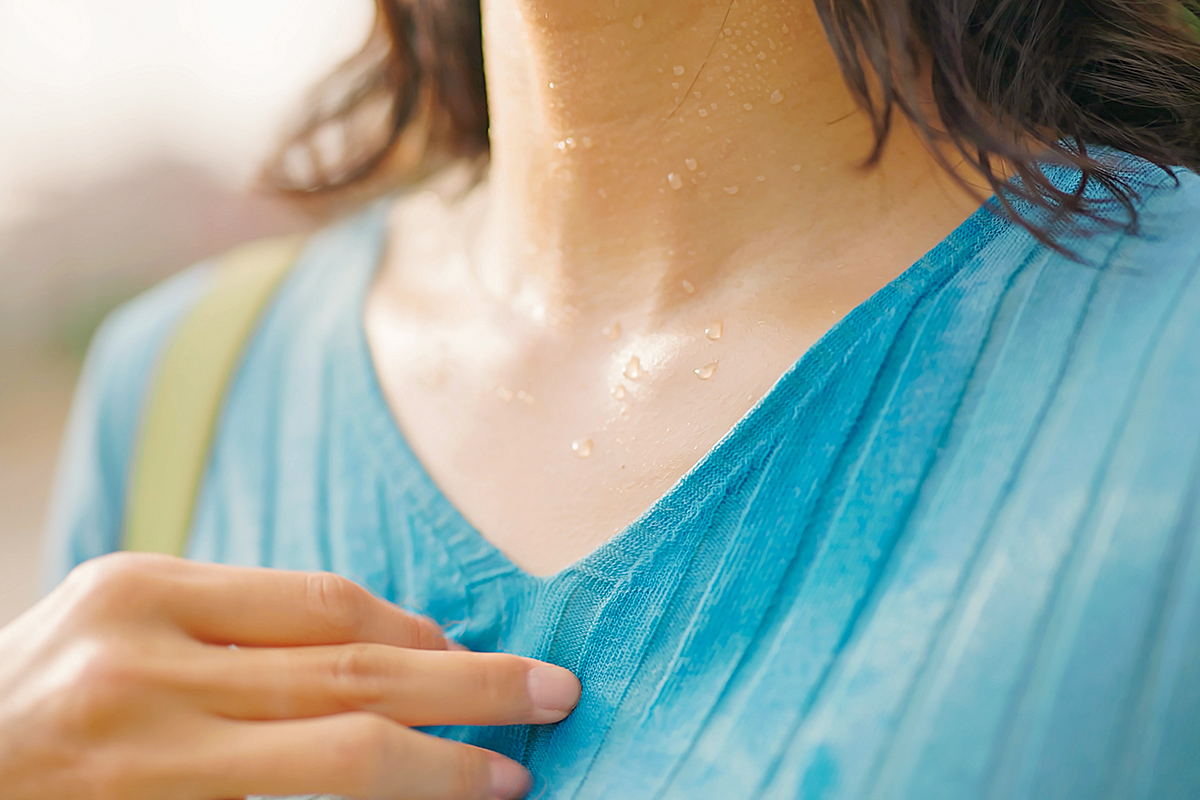
Person sweating
Better Report

It’s been quite a scorcher this summer thanks to a record heat wave that’s sent the mercury soaring in states from New Mexico to New York. Heat indexes in cities including Washington, D.C., New York City, and even Billings, Montana, have reached triple digits, making time outdoors all but unbearable.

Extreme heat like we’ve been seeing is dangerous because it can cause dehydration, heat exhaustion, and heat stroke. Intense high temperatures can also increase the likelihood you’ll get hurt on the job or have a heart attack, according to an article on the medical news site STAT. Heat can aggravate other health problems, too, including migraines, rheumatoid arthritis, and asthma.

Advertisement
Advertisement

So, if you have to be outdoors on hot days, you need a way to beat the heat fast. The British Red Cross has just the trick to help you cool off quickly — and all it requires is some cold H2O.

Hand under running water
Credit: © Diva Plavalaguna/Pexels.com

Cool Your Pulse Points

First, find your pulse points. There are nine primary pulse points on your body, and they include the areas where you might dab on perfume — the wrists and neck — as well as your temples, the insides of your elbows and knees, and the tops of your feet.

Pulse points have arteries close to the surface of your skin; the arteries take warm blood from your core to tissues throughout your body.

Recommended Articles

  • A Warning Sign for Heart Attack and Stroke Could Show Up on Your Face

  • 6 Holiday Scams To Watch Out For

  • Why Gift Cards Are Actually Terrible Gifts

  • The Strange Reason Why Time Feels Like It’s Moving Faster

Advertisement
Advertisement

Reader Favorites

  • Person washing part of a coffee machine

    18 Surprising Things You Should Never Put Down Your Drain

  • Woman brushing hair

    9 Surprising Signs You’re Aging

  • White car on the road

    The Best Cars for Resale Value, According to Auto Experts

When it’s hot, you want to cool these pulse points. First, dip your hands and wrists in cold water or hold them under a running faucet for several minutes. Or you can try the U.S. Army version of this trick: They have soldiers submerge their forearms in ice water for a few minutes to cool down. 

Advertisement

If you need to be on the move, you can drape a damp cloth or wrapped ice pack over the back of your neck. This is one of the best spots for quick cooling because it has lots of blood vessels close to your skin’s surface. Finally, you can hold a wrapped ice pack under your armpits, where there are also large blood vessels, if you feel overheated.
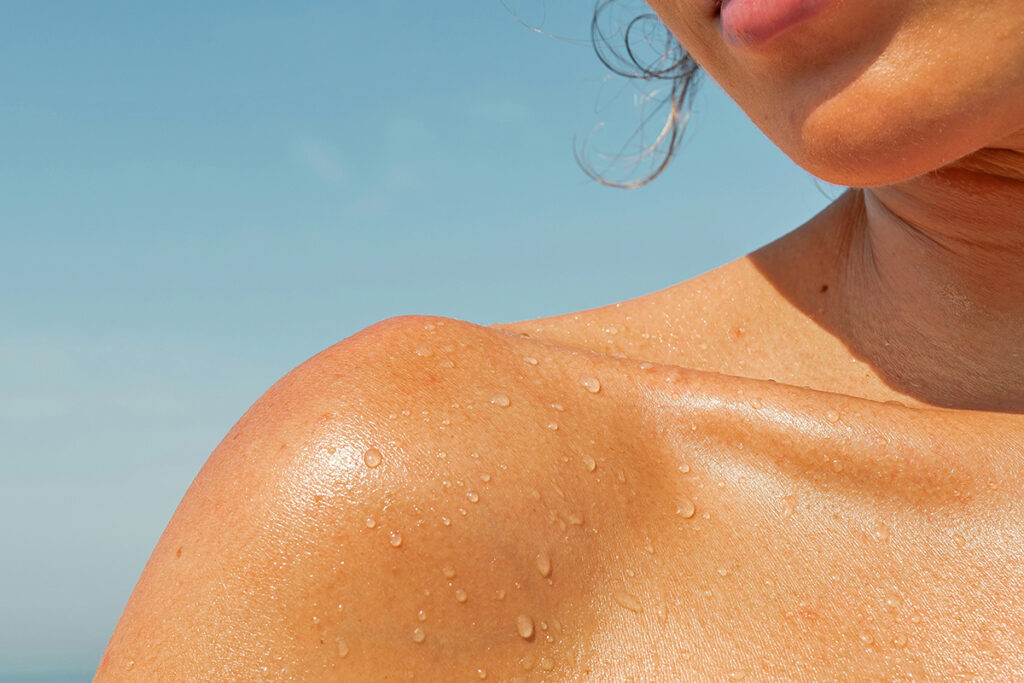
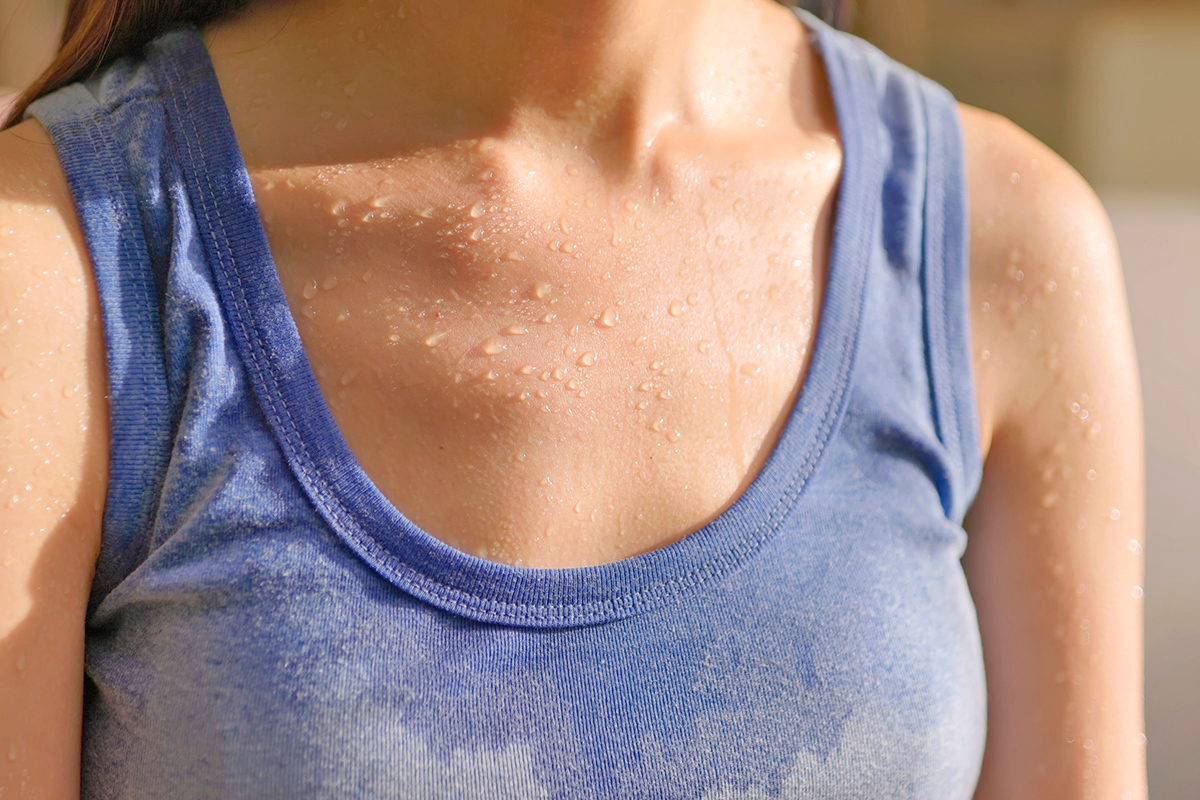
Shoulder with sweat
Credit: © Fellipe Ditadi/Unsplash.com

Your Inner AC

Cooling these areas chills your skin as well as the blood in the vessels below them, which continues circulating through your body — so essentially, you’re cooling your body from the inside.

Advertisement
Advertisement

You won’t see a dramatic drop in your core body temperature, but you should feel more comfortable. That’s because your core temperature is controlled by the hypothalamus, the part of your brain that acts sort of like an internal thermostat. When your body gets too hot, your hypothalamus triggers several cooling responses, including sweating. As your sweat evaporates, it takes heat away from your body. (This is also why drinking hot beverages on scorching days with low humidity will help you cool down.) 

Chilling your pulse points is a quick way to feel more comfortable with the temperatures outside are soaring. But to prevent overheating and heat stroke, it’s important to stay hydrated, avoid alcohol, take breaks in air conditioning or shade when you must be outdoors, and always wear loose-fitting clothes, a hat, and sunscreen.

Featured Image Credit: © PonyWang—iStock/Getty Images

More From Our Network

Better Report is part of Inbox Studio, an email-first media company. *Indicates a third-party property.

Go Retro With This 1960s Fashion Quiz

Quiz Daily

Go Retro With This 1960s Fashion Quiz

True or False: Are You a Master of U.S. Geography?

Travel Quiz

True or False: Are You a Master of U.S. Geography?

5 Reasons You Can Be Denied Boarding an Airplane

Daily Passport

5 Reasons You Can Be Denied Boarding an Airplane

What Did People Do Before Eyeglasses?

History Facts

What Did People Do Before Eyeglasses?

How To Use a Balloon To Clean Up Dust

House Outlook

How To Use a Balloon To Clean Up Dust

11 Shopping Hacks Costco Members Should Know

FinanceBuzz*

11 Shopping Hacks Costco Members Should Know

Share this article

  • Share to Facebook
  • Share to Twitter
  • Copy Url
  • Share to Email
Sarah Gleim
Writer

Sarah Gleim is an Atlanta-based freelancer with more than 25 years of experience writing and producing explainers and features about history, science, food, and health for media outlets like AARP, WebMD, The Conversation, History.com, HowStuffWorks, CNN, and others. She’s also the editor of several cookbooks for Southern Living and Cooking Light.

This article is for general informational purposes only.
Affiliate Disclaimer Medical Disclaimer Financial Disclaimer

Updated: June 9, 2026
Posted In: Health
Hero Image Credit: Better Report
Advertisement

Related Articles

A Warning Sign for Heart Attack and Stroke Could Show Up on Your Face

4 min read

The Strange Reason Why Time Feels Like It’s Moving Faster

5 min read

Are the Brown Marks on Your Skin Dangerous?

6 min read

7 Common Meds Seniors Overuse

4 min read

Is It Actually Bad To Wear Your Shoes in the House?

4 min read
Advertisement

What Your Sweat Can Tell You About Your Health

Sponsored Content
Health | Updated: June 10, 2026
Woman sweating
Better Report

Sweating might feel annoying or embarrassing, but it’s one of your body’s smartest survival tools: Whether you’re dripping through a workout or suddenly sweating during a stressful meeting, perspiration is the main way our bodies regulate their temperature. To do so, millions of sweat glands expel mostly water, which is mixed with small amounts of other substances, such as sodium and chloride. Exactly how much you sweat varies based on genetics, fitness level, climate, and age.

But sweat can also offer clues about hydration, stress, hormones, medication side effects, and overall health. Here’s what your sweat could be trying to tell you.

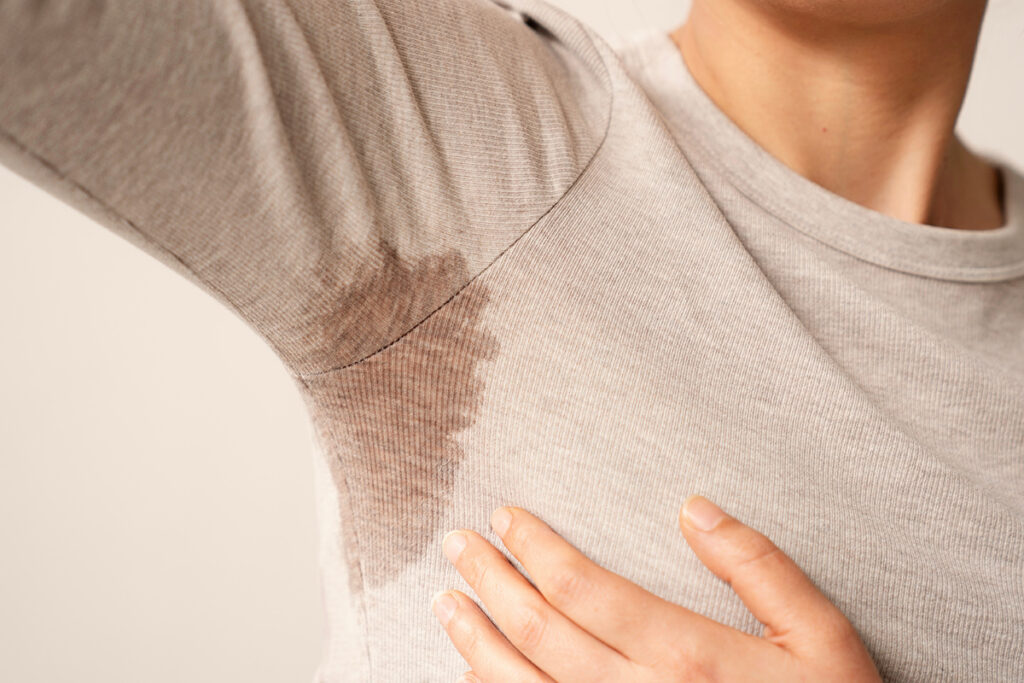
Person with sweat stain in the armpit of their shirt
Credit: © sebra/stock.adobe.com

If You Sweat A Lot

Sweating helps prevent overheating during exercise or time spent in hot weather. Most of the time, excess sweat is normal, but sometimes it can signal physical or emotional changes in the body.

Advertisement
Advertisement

A few medical conditions are associated with oversweating. If you’re extra sweaty without being overheated, working out, feeling stressed, or experiencing another obvious trigger, it may be hyperhidrosis. This skin condition, which is caused by a genetic variation, results in extra sweat, typically on the face, armpits, feet, and hands.

A sudden onset of excessive sweat can also be linked to hormonal fluctuations during pregnancy, perimenopause, and menopause. These changes may trigger hot flashes, characterized by a sudden surge of heat. While hormones are the most likely culprit, general overheating, stress, or consumption of alcohol, caffeine, or spicy food may also contribute.

Advertisement

Night sweats that soak clothing or bedding are also usually hormonal, but they may point to infections, sleep disorders, anxiety, medication side effects, or other medical conditions. You should see a doctor if your night sweats occur regularly, wake you up, are accompanied by symptoms such as a fever or unexplained weight loss, or start long after symptoms of menopause have ended.

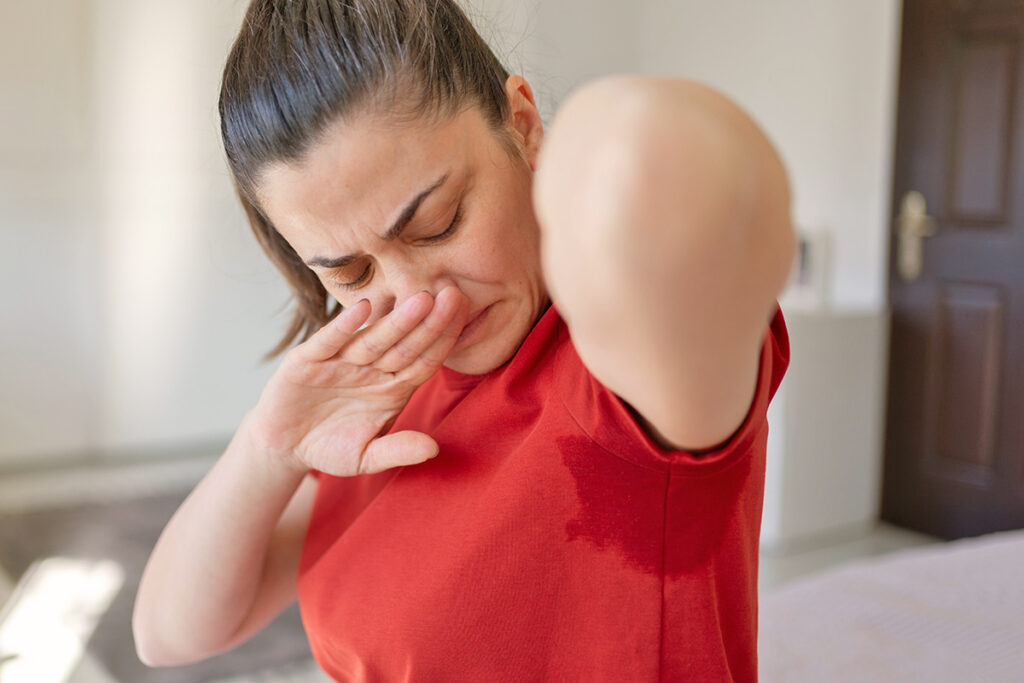
Woman smelling armpit and holding nose
Credit: © aquaArts studio—iStock/Getty Images

If Your Sweat Has a Strong Odor

Stress not only increases sweat production but also makes it stinkier. This happens because there are two types of sweat glands. 

Sweat from overheating is produced by eccrine glands, which are found all over the body. This type of sweat usually doesn’t have much of an odor because it’s mostly water and salt. Stress-related sweating, on the other hand, is produced by apocrine glands, which are mostly found in the armpits and groin area. This sweat contains proteins and lipids that skin bacteria feed on, causing odor.

Recommended Articles

  • A Warning Sign for Heart Attack and Stroke Could Show Up on Your Face

  • 6 Holiday Scams To Watch Out For

  • Why Gift Cards Are Actually Terrible Gifts

  • The Strange Reason Why Time Feels Like It’s Moving Faster

Advertisement
Advertisement

Reader Favorites

  • Person washing part of a coffee machine

    18 Surprising Things You Should Never Put Down Your Drain

  • Woman brushing hair

    9 Surprising Signs You’re Aging

  • White car on the road

    The Best Cars for Resale Value, According to Auto Experts

If persistent body odor doesn’t improve with hygiene, lifestyle, or stress improvements, it can occasionally be linked to conditions such as diabetes, liver disease, or kidney disease. It’s important to notify your doctor of any significant changes in the odor of your sweat.

Man lifting weights and sweating
Credit: © Jacob Lund/stock.adobe.com

If Your Sweat Is Salty

We naturally lose salt through sweat, especially during intense exercise. White streaks on clothing or sweat that burns your eyes may indicate higher sodium loss. This is common among endurance athletes or people training in hot conditions. In these cases, replacing electrolytes along with fluids may help maintain hydration. However, certain medications and medical conditions, including cystic fibrosis, can also cause unusually salty sweat.

Advertisement
Advertisement

While salty sweat typically isn’t cause for concern, contact your health care provider if it is accompanied by other symptoms, such as nausea, vomiting, confusion, headache, muscle weakness, or cramping. These are signs of hyponatremia, a condition in which blood sodium levels are very low.

Advertisement
Woman drinking water
Credit: © brizmaker—iStock/Getty Images

If You Barely Sweat

Everyone sweats differently, but if you feel you’re not sweating when you normally would, such as during exercise or in the heat, it could be a sign of a medical condition called anhidrosis. This condition prevents you from sweating normally in at least one area of the body, and it may be caused by genetics, nerve or skin damage, medications, autoimmune conditions, or chronic illnesses.

Advertisement
Advertisement

A major decrease in sweating can also indicate severe dehydration or heat stroke, both of which can be very dangerous. Heat stroke doesn’t always come on suddenly. Nonexertional heatstroke can develop over several days and is more common in those ages 65 and older or those with underlying health conditions. Seek medical attention if you’re not sweating and are experiencing a fever, dizziness, fast pulse, and confusion.

Sweating man wiping brow with cloth
Credit: © Mohamed hamdi/Unsplash.com

How To Support Healthy Sweating

Because sweating is so important for regulating our bodies, you may be wondering how you can support healthy sweating. Maintaining good hygiene, wearing breathable clothing, managing stress, staying hydrated, and replenishing electrolytes after intense workouts are great ways to support your body’s natural functions. Remember, sweat merely provides clues — professional medical advice matters most for persistent concerns.

Featured Image Credit: © PonyWang—iStock/Getty Images

More From Our Network

Better Report is part of Inbox Studio, an email-first media company. *Indicates a third-party property.

Go Retro With This 1960s Fashion Quiz

Quiz Daily

Go Retro With This 1960s Fashion Quiz

True or False: Are You a Master of U.S. Geography?

Travel Quiz

True or False: Are You a Master of U.S. Geography?

5 Reasons You Can Be Denied Boarding an Airplane

Daily Passport

5 Reasons You Can Be Denied Boarding an Airplane

What Did People Do Before Eyeglasses?

History Facts

What Did People Do Before Eyeglasses?

How To Use a Balloon To Clean Up Dust

House Outlook

How To Use a Balloon To Clean Up Dust

11 Shopping Hacks Costco Members Should Know

FinanceBuzz*

11 Shopping Hacks Costco Members Should Know

Share this article

  • Share to Facebook
  • Share to Twitter
  • Copy Url
  • Share to Email
Sponsored Content

This article is for general informational purposes only.
Affiliate Disclaimer Medical Disclaimer Financial Disclaimer

Updated:
Posted In: Health
Hero Image Credit: Better Report
Advertisement

Related Articles

A Warning Sign for Heart Attack and Stroke Could Show Up on Your Face

4 min read

The Strange Reason Why Time Feels Like It’s Moving Faster

5 min read

Are the Brown Marks on Your Skin Dangerous?

6 min read

7 Common Meds Seniors Overuse

4 min read

Is It Actually Bad To Wear Your Shoes in the House?

4 min read
Advertisement

Why You Should Drink Hot Beverages on Hot Days

Health | Updated: June 1, 2026
Kat Long
Author
Kat Long is a freelance science journalist in the Washington, D.C. area. Previously, she was the science editor at Mental Floss and a digital editor at National Geographic. She now writes the Arctic Archives newsletter on Substack. Kat spends her free time birdwatching, road-tripping to historical sites and perusing old manuscripts at libraries.
Hot cup of coffee
Better Report

On a blazing summer day, the last thing most people want to do is sip a steaming cup of tea or take a swig of piping-hot coffee. Instead, we usually crave an icy glass of water, seltzer, or lemonade. Drinking a cold beverage feels like we’re both hydrating our bodies and efficiently lowering our core temperature, but science is here to ruin that illusion. If you really want to cool off on a warm day, consider downing that hot drink instead.

Man sweating
Credit: © PonyWang—E+/Getty Images

The Science of Sweat

It seems counterintuitive, but drinking a hot beverage will actually make you cooler, thanks to blood and sweat.

Advertisement
Advertisement

Sweating is your body’s chief way of regulating body temperature and preventing overheating. When you consume hot food or drinks, the added heat causes your blood vessels to expand (known as vasodilation) and allow more blood to pass through them, distributing the heat from your core to your extremities. Glands in your skin begin producing sweat, which is mostly water combined with some salts and other compounds. The fluid then evaporates from the surface of your skin and transfers the heat from your body to the air around you, cooling you off.

Woman holding hot beverage
Credit: © Blake Cheek/Unsplash.com

How Hot Drinks Cool You Down

Scientists have even tested the cooling power of hot versus cold drinks in a controlled environment. For a 2012 study, nine male participants rode stationary bikes for an hour and 15 minutes in a lab where the room was kept at 23.6 degrees Celsius (roughly 75 degrees Fahrenheit) with low relative humidity. 

During the ride, participants drank samples of cool, warm, and hot water while wearable sensors measured their skin temperature and the amount of carbon dioxide they produced by breathing, indicating their level of baseline heat resulting from metabolism. 

Advertisement

After the riders drank the cool water, their core body temp decreased, but so did their tendency to sweat. The hot water raised participants’ core temp slightly and, importantly, revved up sweating, which cooled their bodies more efficiently. Ultimately, the hot drinks resulted in lower body temperatures because more sweating eliminated more heat.

For this to work in the real world, though, the surrounding environment must have low relative humidity, the measurement of how much moisture is in the atmosphere. The lower the humidity, the easier it is for sweat to evaporate, whereas higher humidity inhibits sweat evaporation and makes it more difficult for your body to cool off. At about 90% relative humidity, sweat can no longer evaporate from skin.

In a hot, humid environment, drinking cool water — not hot beverages — and remaining hydrated is crucial for avoiding heat exhaustion and heat stroke.

Woman drinking hot beverage
Credit: Pablo Merchán Montes/Unsplash.com 

Cold Beverages on Cold Days?

Do the thermoregulatory benefits of a hot drink on a hot day mean you should, inversely, consume cold beverages in cold weather? 

Recommended Articles

  • A Warning Sign for Heart Attack and Stroke Could Show Up on Your Face

  • 6 Holiday Scams To Watch Out For

  • Why Gift Cards Are Actually Terrible Gifts

  • The Strange Reason Why Time Feels Like It’s Moving Faster

Advertisement
Advertisement

Reader Favorites

  • Person washing part of a coffee machine

    18 Surprising Things You Should Never Put Down Your Drain

  • Woman brushing hair

    9 Surprising Signs You’re Aging

  • White car on the road

    The Best Cars for Resale Value, According to Auto Experts

The answer seems to be “no.” A hot drink — ideally between 98.6 degrees and 115 degrees Fahrenheit — will dilate your blood vessels to distribute heat from your core in cold weather just as it does in hot weather. The difference in cold environments is that you’re less likely to lose that heat through sweating. A hot drink will help maintain your core at a toasty temp and make you feel warmer, too. 

Advertisement

A cold drink, conversely, can induce shivering, which does generate body heat. But shivering wouldn’t feel nearly as nice as sipping a mug of hot cocoa on a chilly morning. 

Featured Image Credit: © René Porter/Unsplash.com

More From Our Network

Better Report is part of Inbox Studio, an email-first media company. *Indicates a third-party property.

Go Retro With This 1960s Fashion Quiz

Quiz Daily

Go Retro With This 1960s Fashion Quiz

True or False: Are You a Master of U.S. Geography?

Travel Quiz

True or False: Are You a Master of U.S. Geography?

5 Reasons You Can Be Denied Boarding an Airplane

Daily Passport

5 Reasons You Can Be Denied Boarding an Airplane

What Did People Do Before Eyeglasses?

History Facts

What Did People Do Before Eyeglasses?

How To Use a Balloon To Clean Up Dust

House Outlook

How To Use a Balloon To Clean Up Dust

11 Shopping Hacks Costco Members Should Know

FinanceBuzz*

11 Shopping Hacks Costco Members Should Know

Share this article

  • Share to Facebook
  • Share to Twitter
  • Copy Url
  • Share to Email
Kat Long
Writer

Kat Long is a freelance science journalist in the Washington, D.C. area. Previously, she was the science editor at Mental Floss and a digital editor at National Geographic. She now writes the Arctic Archives newsletter on Substack. Kat spends her free time birdwatching, road-tripping to historical sites and perusing old manuscripts at libraries.

This article is for general informational purposes only.
Affiliate Disclaimer Medical Disclaimer Financial Disclaimer

Updated: April 6, 2026
Posted In: Health
Hero Image Credit: Better Report
Advertisement

Related Articles

A Warning Sign for Heart Attack and Stroke Could Show Up on Your Face

4 min read

The Strange Reason Why Time Feels Like It’s Moving Faster

5 min read

Are the Brown Marks on Your Skin Dangerous?

6 min read

7 Common Meds Seniors Overuse

4 min read

Is It Actually Bad To Wear Your Shoes in the House?

4 min read
Advertisement

The Tick Bite That Could Make You Allergic to Meat

Sponsored Content
Health | Updated: May 21, 2026
Cutting steak
Better Report

All featured products and deals are selected independently and objectively by the author. Better Report may receive a share of sales via affiliate links in content.

If it’s spring or summer, it’s tick season across most of the United States (though the Northeast and Midwest have been the main hot spots for tick trouble over the past decade). This means the little arachnids have awoken from their winter dormancy and are searching for blood meals. They’ll bite almost anything that moves — including people.

2026 is already proving to be a bumper year for tick-related emergency room visits: In the fourth week of April alone, the Centers for Disease Control and Prevention’s tick bite tracker reported 117 tick bite-related ER visits per 100,000 ER visits in the U.S., the highest rate since 2017 — and tick bite reporting usually peaks in late May. 

Advertisement
Advertisement

Bites from pathogen-carrying ticks can cause Lyme disease, anaplasmosis, Rocky Mountain spotted fever, and many other diseases. One of the strangest and least understood is alpha-gal syndrome, an allergy to red meat thought to be spread through bites from lone star ticks. These aggressive chompers live mostly in the South and Midwest, but their range is expanding to the Northeast and West due to rising average temperatures and earlier spring warmth linked to climate change.

Here’s what you need to know about this odd illness and what you can do to avoid it.

Cutting steak
Credit: © Curated Lifestyle/Unsplash.com

The “Red Meat Allergy”

Identified in the early 2000s, alpha-gal syndrome is an allergy to an oligosaccharide (a type of sugar molecule) called galactose-alpha-1,3-galactose, or alpha-gal for short. The molecule naturally occurs in most mammals’ meat and mammalian products, but not in humans or other primates. 

Advertisement

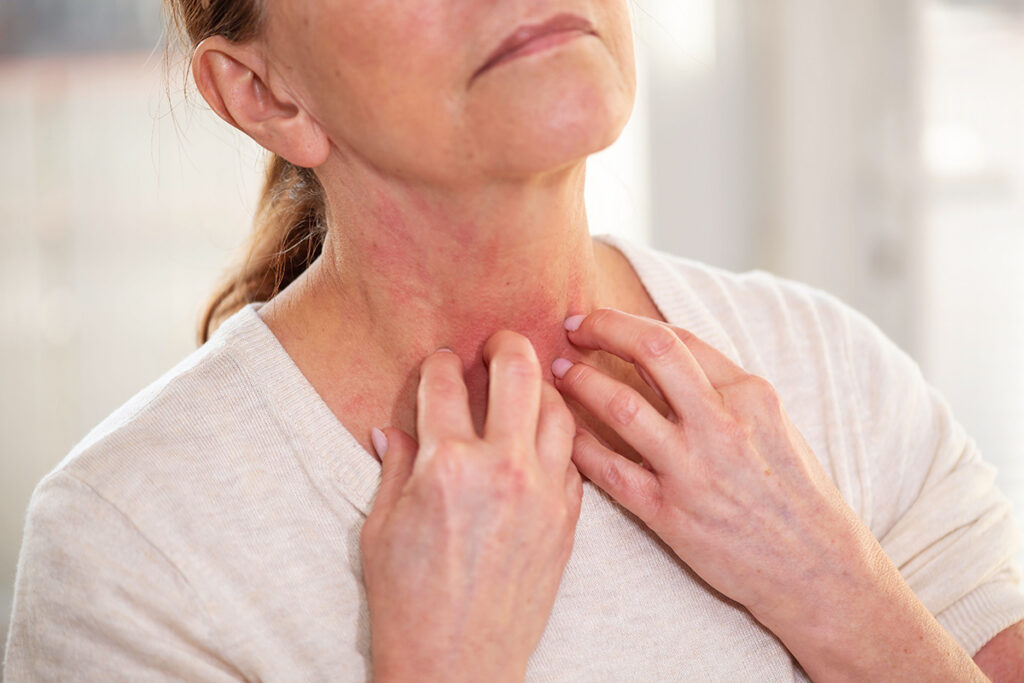
When people with alpha-gal syndrome eat red meat, their bodies release a flood of immunoglobulin E, an antibody produced by the immune system. This allergic reaction can occur up to six hours after the meat is eaten and manifest as hives, coughing and wheezing, stomach pain, gastrointestinal upset, dizziness, or life-threatening anaphylaxis. People may have different symptoms and degrees of severity each time they’re exposed to alpha-gal.

Recommended Articles

  • A Warning Sign for Heart Attack and Stroke Could Show Up on Your Face

  • 6 Holiday Scams To Watch Out For

  • Why Gift Cards Are Actually Terrible Gifts

  • The Strange Reason Why Time Feels Like It’s Moving Faster

Advertisement
Advertisement

Reader Favorites

  • Person washing part of a coffee machine

    18 Surprising Things You Should Never Put Down Your Drain

  • Woman brushing hair

    9 Surprising Signs You’re Aging

  • White car on the road

    The Best Cars for Resale Value, According to Auto Experts

The biggest sources of alpha-gal for consumers are beef, pork, lamb, venison, rabbit, and other mammalian meat and organs; animal fats like beef tallow, lard, and suet; meat-based broths and gravies; dairy products; and items containing animal-derived gelatin, like medicine capsules. Unfortunately, cooking meat doesn’t get rid of alpha-gal.

Person itching rash on throat
Credit: © thodonal/stock.adobe.com

Cases Are Increasing

It’s hard to know exactly how many people in the U.S. have alpha-gal syndrome because health care providers aren’t required to report cases they see to their state health departments and the CDC. The number is rising, however: A 2023 study found more than 90,000 cases diagnosed from antibody tests between 2017 and 2021, with the number of new cases increasing by about 15,000 each year. Most occurred in the South, Midwest, and Mid-Atlantic.

Advertisement
Advertisement

The actual number of cases may be much higher; the CDC estimates as many as 450,000 people may live with the condition. The first known death from alpha-gal syndrome occurred in 2024, when a New Jersey man died after eating a hamburger and experiencing a fatal allergic reaction.  

Lone Star tick on skin
Credit: © thodonal/stock.adobe.com

Alpha-Gal Syndrome’s Origin

Lone star ticks transfer alpha-gal in their saliva to their hosts, and it’s believed that they cause most cases of the syndrome in the United States. Other species have caused alpha-gal syndrome in other countries on every continent except Antarctica.

Advertisement
Advertisement

It’s not clear how alpha-gal arises in ticks. Some theories suggest ticks acquire the allergen from previous blood meals or from viruses, bacteria, or parasites. Others hypothesize that it originates in the tick’s saliva and digestive tract.

Much more research is needed to understand the factors influencing the syndrome’s flow between tick and host. A tick’s food-seeking patterns, ecological distribution, saliva chemistry, and other traits could affect its ability to transmit alpha-gal. Studies have suggested a person’s own microbiome, diet, blood type, interactions with pets, and genetic disposition to allergic reactions could play into their susceptibility. 

Advertisement
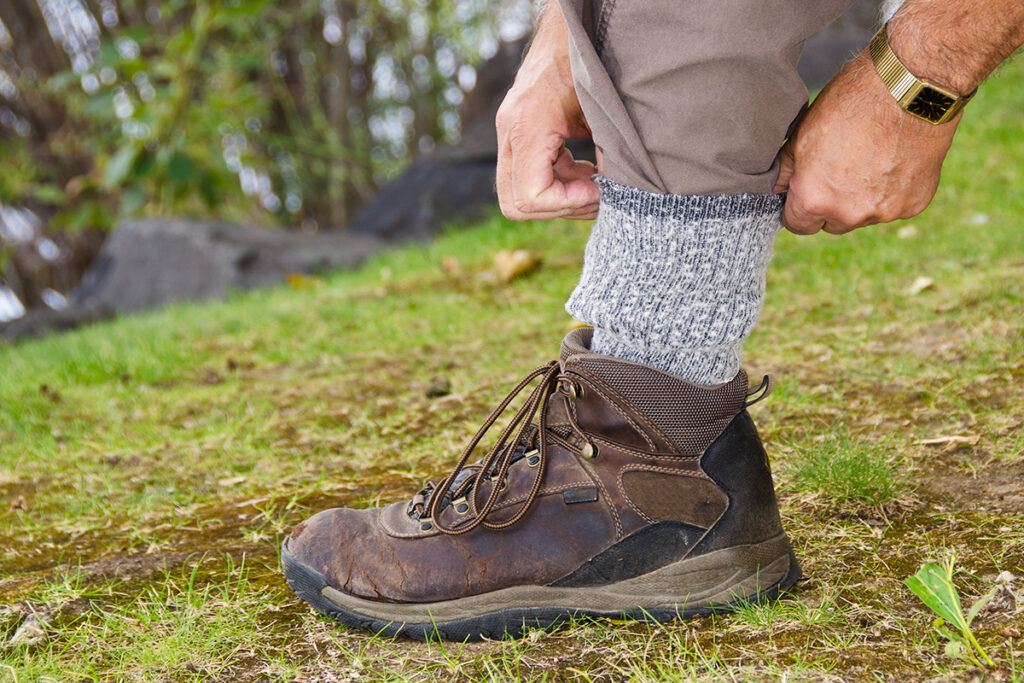
Pants tucked into socks
Credit: © rck/stock.adobe.com

Prevention Is the Best Protection

Because there’s no specific treatment or cure for alpha-gal syndrome, the best way to avoid it is to prevent ticks from biting you in the first place. 

Advertisement
Advertisement

Ticks tend to hang out in tall grass waiting for a passing host to grab on to. For that reason, stay away from unmown yards and meadows and keep to the center of the trail if you’re hiking through wooded areas. Tuck your pant legs into your socks and wear long-sleeved shirts when you’re outdoors. Use effective insect repellent containing DEET, picaridin, or oil of lemon eucalyptus on your skin, and treat clothing and camping gear with permethrin. 

After being outside, check your body for ticks (especially the sweatier areas, like armpits) and use blunt-tipped tweezers to carefully remove any ticks you find. You’ll want to do this as soon as possible: The longer a tick is attached, the greater your risk of getting any illness it can pass on, so don’t wait for an appointment with your doctor. Snap a clear photo of the tick, secure it tightly in tape, and throw it in the trash, then wash your hands and the bite with soap and water. 

Advertisement
Advertisement

If you start to experience any symptoms, you should see a health care provider right away. And if they’re severe — a high fever, coughing up blood, or difficulty breathing, for example — head to the emergency room ASAP.

Featured Image Credit: © Frank Rolando Romero/Unsplash.com

More From Our Network

Better Report is part of Inbox Studio, an email-first media company. *Indicates a third-party property.

Go Retro With This 1960s Fashion Quiz

Quiz Daily

Go Retro With This 1960s Fashion Quiz

True or False: Are You a Master of U.S. Geography?

Travel Quiz

True or False: Are You a Master of U.S. Geography?

5 Reasons You Can Be Denied Boarding an Airplane

Daily Passport

5 Reasons You Can Be Denied Boarding an Airplane

What Did People Do Before Eyeglasses?

History Facts

What Did People Do Before Eyeglasses?

How To Use a Balloon To Clean Up Dust

House Outlook

How To Use a Balloon To Clean Up Dust

11 Shopping Hacks Costco Members Should Know

FinanceBuzz*

11 Shopping Hacks Costco Members Should Know

Share this article

  • Share to Facebook
  • Share to Twitter
  • Copy Url
  • Share to Email
Sponsored Content

This article is for general informational purposes only.
Affiliate Disclaimer Medical Disclaimer Financial Disclaimer

Updated:
Posted In: Health
Hero Image Credit: Better Report
Advertisement

Related Articles

A Warning Sign for Heart Attack and Stroke Could Show Up on Your Face

4 min read

The Strange Reason Why Time Feels Like It’s Moving Faster

5 min read

Are the Brown Marks on Your Skin Dangerous?

6 min read

7 Common Meds Seniors Overuse

4 min read

Is It Actually Bad To Wear Your Shoes in the House?

4 min read
Advertisement

7 Places You’re Forgetting To Apply Sunscreen

Health | Updated: May 14, 2026
Erin McCarthy
Author
Erin is a writer, editor, and content strategist living in the New York City area. Previously, she was the VP/Editor-in-Chief of MentalFloss.com and an editor at Popular Mechanics magazine. When she’s not working, Erin is hanging out with her cats, reading books from her never-ending TBR, traveling, karaoking, and making sourdough with her starter Stephen Sondheim.
Woman applying sunscreen on back
Better Report

All featured products and deals are selected independently and objectively by the author. Better Report may receive a share of sales via affiliate links in content.

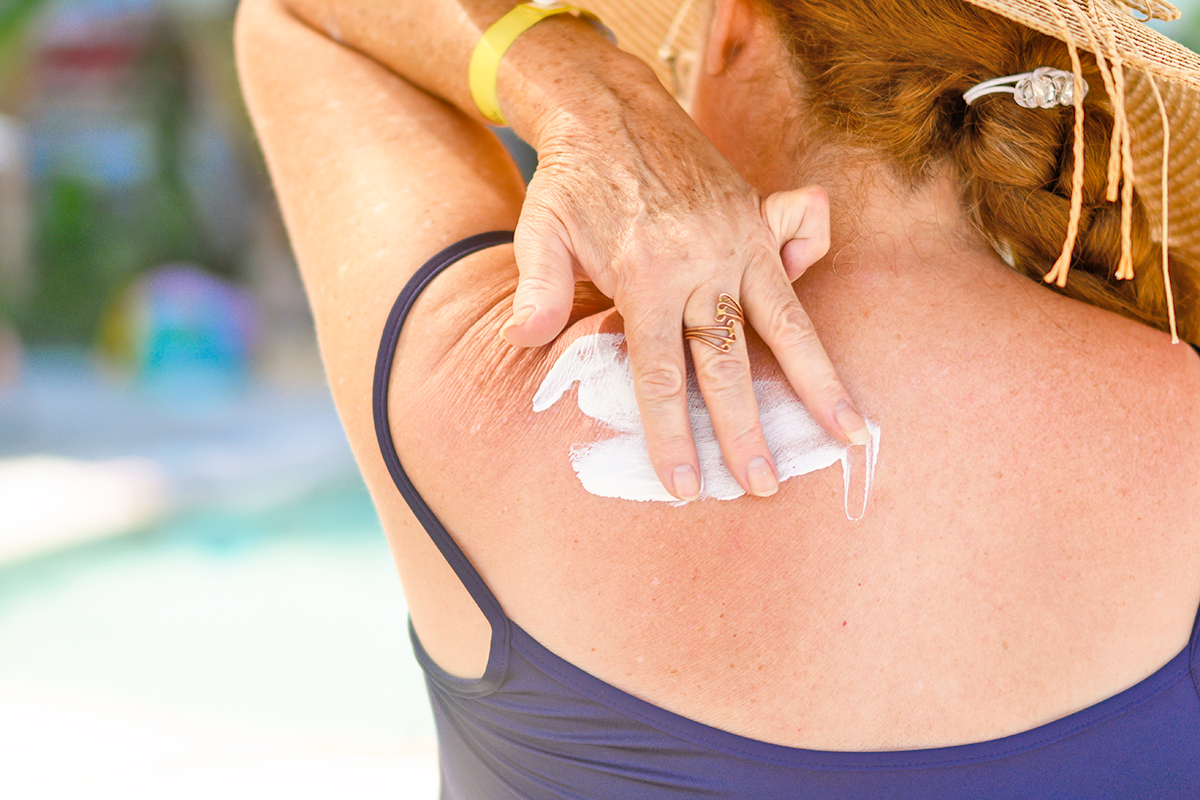
You’re not great at applying sunscreen — in fact, almost no one is. “Multiple studies from around the world have shown that people apply, on average, 20% to 50% of the recommended amount of sunscreen,” says Dr. Samantha Schneider, a dermatologist and Mohs micrographic surgeon at the Nevada-based Pacific Crest Dermatology. “This means that the vast majority of people are not actually getting the SPF number that is written on the bottle.” 

Advertisement
Advertisement

It also means there are probably areas on your body that you’re missing when you apply — and that’s a problem as the weather warms up and we spend more time in the sun’s ultraviolet rays. “Ultraviolet radiation … is considered a Group 1 carcinogen, which means it is cancer-causing in humans, just like cigarettes,” Dr. Schneider says. 

The data paints a similar picture: According to the American Academy of Dermatology, skin cancer is the most common cancer in the U.S., and one in five Americans will develop it in their lifetime. Proper sunscreen application can help protect you. Read on to find out which areas of your body you’re forgetting when you apply, plus some tips and tricks for getting the full SPF coverage you need.

Women applying sunscreen
Credit: © Curated Lifestyle/Unsplash.com

Areas You’re Missing When Applying Sunscreen

According to Dr. Schneider, one area where people do tend to use sunscreen is the face, though they may neglect the area around the eyes. “Sometimes it’s because sunscreen can be irritating around the eyes and other times I think it really is just because we forget,” she says. But the skin there is thin and particularly susceptible to UV damage, so it’s “important to extend your face sunscreen up underneath your eye and over your eyebrows.” There are a number of other areas where sunscreen may be forgotten,  including the body parts below, which Dr. Schneider says are frequently missed: 

  1. Ears
  2. Lips
  3. Scalp
  4. Neck
  5. Backs of the hands
  6. Tops of the feet
  7. The back (because it’s hard to reach)  

Recommended Articles

  • A Warning Sign for Heart Attack and Stroke Could Show Up on Your Face

  • 6 Holiday Scams To Watch Out For

  • Why Gift Cards Are Actually Terrible Gifts

  • The Strange Reason Why Time Feels Like It’s Moving Faster

Advertisement
Advertisement

Reader Favorites

  • Person washing part of a coffee machine

    18 Surprising Things You Should Never Put Down Your Drain

  • Woman brushing hair

    9 Surprising Signs You’re Aging

  • White car on the road

    The Best Cars for Resale Value, According to Auto Experts

Missing areas of your body can result in “wrinkles, dull skin, loss of collagen and elasticity, and brown spots,” but of course the most serious consequence of not properly applying sunscreen is skin cancer. Dr. Schneider frequently performs Mohs surgery, a procedure in which thin layers of the skin are removed until no cancer remains. “As a Mohs surgeon, I am removing skin cancer from ears, lips, and scalps weekly in my clinic,” she says, adding that she also sees clients every day with concerns about premature aging caused by decades of sun exposure without taking the proper precautions. 

Advertisement
Man putting sunscreen in hand
Credit: © ohlamour studio/Unsplash.com

Application Tips and Tricks

The major issue that people need to overcome is that they’re applying half (or even less) of the amount used in a laboratory setting to give the rating on the bottle, according to Dr. Schneider. “The relationship between the number on the bottle and what protection you receive is not linear, but rather logarithmic,” she explains. “This means that when you apply half of the recommended amount, you are getting much less than half of the protection.”

Advertisement
Advertisement

If you’re only using foundation or moisturizer with SPF in it, you’re likely not getting enough protection, either. “Oftentimes, these are not broad-spectrum coverage — meaning they are not protecting against UVB and UVA — and most people are not putting on enough of their foundation or powder to actually get the coverage they think they are getting,” Dr. Schneider says.

So how can you make sure you’re fully covered? The recommendation is to apply a shot glass of sunscreen total to the parts of your body that aren’t covered by clothing. “For most people, it would mean face, neck (including back of neck), ears, upper chest, arms, legs, hands, and tops of feet, if [they’re] wearing sandals,” Dr. Schneider says. She advises her patients to apply sunscreen in two layers to ensure they’re getting enough coverage. “When you apply a first round of sunscreen, let it soak in, and then apply another [layer], you more closely approach the recommended amount of sunscreen that the SPF number is based upon,” she says. 

She layers two different sunscreens on her face: EltaMD UV Recovery has a green tint that evens out some of the redness in her skin, followed by ISDIN’S Eryfotona Ageless Tinted SPF, which also serves as her foundation.  

You can also get specific products for different areas of your body. “I am a big fan of SPF for lips. This is a highly neglected area, and trust me, no one wants a skin cancer on their lips,” she says. “I really like EltaMD UV Lip Balm Broad Spectrum SPF 36 for adventures outdoors. And I love Prequel’s Lip Visor for daily use.” If sunscreen irritates the area around your eyes, Dr. Schneider recommends trying Colorescience 3-in-1 Total Eye. You can use a mineral brush with SPF powder for your scalp or to reapply on your face if you have makeup on; Dr. Schneider likes ISDIN’s Mineral Brush and Colorscience Sunforgettable.

Advertisement
Advertisement

To make sure you’re not missing anything, she recommends coming up with a method for applying your sunscreen. “Do it the same way each time,” she says. “Creating a habit makes it second nature so that you don’t forget anything.” 

Advertisement
Woman wearing hat on beach
Credit: © Getty Images/Unsplash.com 

Other Things To Keep in Mind

Sunscreen should be worn every day. “I recommend daily SPF application on your face, neck, and back of hands because we get a surprising amount of exposure through windows and walking to and from buildings throughout the day,” Dr. Schneider says. Don’t forget to reapply every two hours, particularly if you’re spending a lot of time outdoors or are swimming and sweating. “Once in the morning does not give all day protection.” 

Advertisement
Advertisement

Dr. Schneider also recommends packing a hat, a neck drape, and UPF clothing if you’re going to be outside for long periods of time: “Having alternative methods of protection with you for an ‘Uh oh, I think I might be burning’ moment can help save the day.” That said, not all UPF clothing is created equal. “The protection that you receive from clothing depends on the weave of the fabric,” she says. “A loosely crocheted pool cover-up is not going to provide the same sun protection as a tightly woven UPF50 sun hoodie.” 

There are many different kinds of sunscreen, and it’s safe for you to use. “There is no evidence that, when used in the real world, [sunscreen] causes cancer or hormone disruption, but we know that UVR is a Grade 1 carcinogen and does cause cancer,” Dr. Schneider says. You may want to go for lotion over a spray, which “can be helpful, but they still do need to be rubbed in or you can get streaky coverage that leads to a sunburn.” Ultimately, she says, “The best sunscreen is the one that you are actually going to wear.”

Featured Image Credit: © Alejandro Franco Garcia—iStock/Getty Images

More From Our Network

Better Report is part of Inbox Studio, an email-first media company. *Indicates a third-party property.

Go Retro With This 1960s Fashion Quiz

Quiz Daily

Go Retro With This 1960s Fashion Quiz

True or False: Are You a Master of U.S. Geography?

Travel Quiz

True or False: Are You a Master of U.S. Geography?

5 Reasons You Can Be Denied Boarding an Airplane

Daily Passport

5 Reasons You Can Be Denied Boarding an Airplane

What Did People Do Before Eyeglasses?

History Facts

What Did People Do Before Eyeglasses?

How To Use a Balloon To Clean Up Dust

House Outlook

How To Use a Balloon To Clean Up Dust

11 Shopping Hacks Costco Members Should Know

FinanceBuzz*

11 Shopping Hacks Costco Members Should Know

Share this article

  • Share to Facebook
  • Share to Twitter
  • Copy Url
  • Share to Email
Erin McCarthy
Editor, Better Report

Erin is a writer, editor, and content strategist living in the New York City area. Previously, she was the VP/Editor-in-Chief of MentalFloss.com and an editor at Popular Mechanics magazine. When she’s not working, Erin is hanging out with her cats, reading books from her never-ending TBR, traveling, karaoking, and making sourdough with her starter Stephen Sondheim.

This article is for general informational purposes only.
Affiliate Disclaimer Medical Disclaimer Financial Disclaimer

Updated: March 23, 2026
Posted In: Health
Hero Image Credit: Better Report
Advertisement

Related Articles

A Warning Sign for Heart Attack and Stroke Could Show Up on Your Face

4 min read

The Strange Reason Why Time Feels Like It’s Moving Faster

5 min read

Are the Brown Marks on Your Skin Dangerous?

6 min read

7 Common Meds Seniors Overuse

4 min read

Is It Actually Bad To Wear Your Shoes in the House?

4 min read
Advertisement

This Is the Only Beach Towel I’ll Ever Buy

Sponsored Content
Home | Updated: May 1, 2026
Woman reading at beach
Better Report

All featured products and deals are selected independently and objectively by the author. Better Report may receive a share of sales via affiliate links in content.

Beach season is almost upon us, which means it’s time to buy a new bottle of sunscreen, grab a UPF cover-up, and pick up a fresh beach towel or two. The kind of towel you reach for will depend on your preferences — do you prioritize absorbency over sand-shedding properties? Do you want to feel cozy or have your towels dry quickly? Here’s what I pack in my bag when I’m beach-bound.

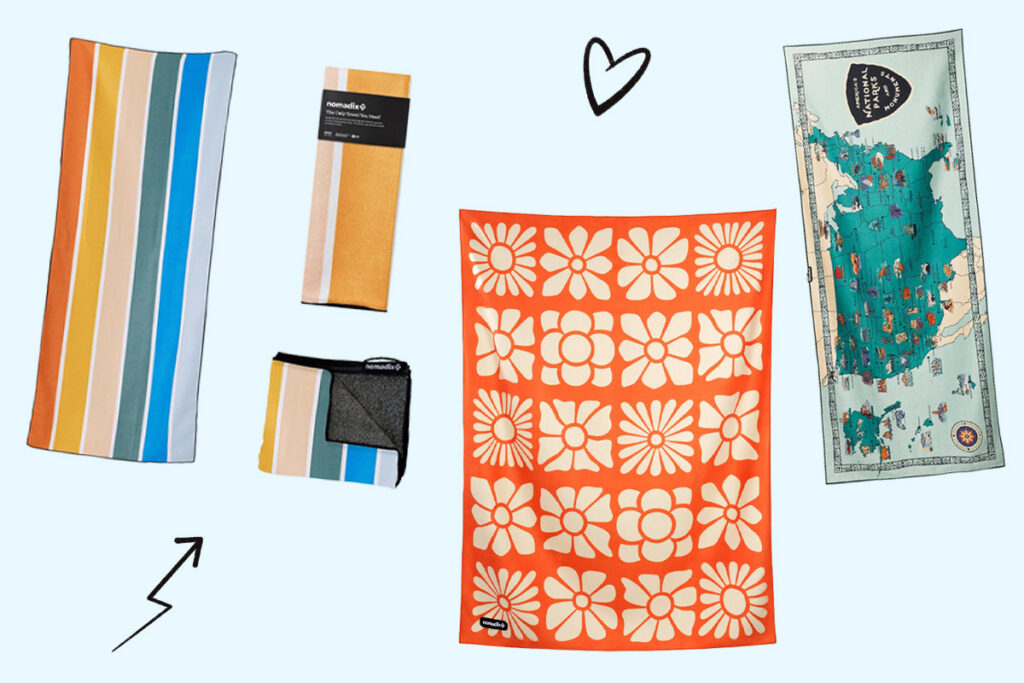
Credit: Images courtesy of Nomadix

My Favorite Beach Towel

When I go to the beach, my No. 1 priority is to leave sand there, where it belongs — there’s truly nothing worse than those tiny, irritating little grains getting into the crevices of your bag or the cracks in your floor at home. I also need the towel to be dry so I can shove it back into my bag without worrying about getting my books, camera, phone, or anything else wet. My preferred towel is of the microfiber variety (more on that later), and Nomadix is my favorite. 

Advertisement
Advertisement

It’s true that these towels aren’t as plush as cotton, which I miss on windy beach days when I want a little something more to keep me warm. And depending on where you’re getting your towels, Nomadix might be on the pricier side when compared to terry. That said, Nomadix towels are still soft, especially if you get their microsuede material — and the pros far outweigh the cons, which I think makes the price tag worth it. 

The towels come in a ton of fun patterns and themes — the national parks towels are especially fun — and in addition to repelling sand, they also repel pet fur, which is huge in my two-cat household. (I rubbed these towels all over my cats and the few strands of fur that stuck brushed right off. I need clothing made of this material.)

I also appreciate that there seems to be a size for every occasion. An original towel measures 30 inches by 72.5 inches and weighs 16 ounces, and the ultralight, with the same dimensions, weighs half that. Nomadix also makes blanket towels that measure 60 inches by 80 inches — large enough to accommodate three people — and weigh 32 ounces. There are even tiny towels and bandanas. Like all microfiber towels, they’re absorbent (they can hold four times as much liquid as they weigh) and fast-drying, which means there’s no funky, wet scent hanging around. Every towel has UPF 50 sun protection, too. 

Advertisement

Nomadix towels are also made with recycled materials, and the company donates 1% of its fiscal sales to environmental causes, so you can feel good about your purchases. The original towel costs $40, the ultralight is $30, and blanket towels are $65. 

I love these towels so much, I’ve given them as gifts to the frequent campers and festival-goers in my life. I’ve taken the tiny towels to the gym and the original towels to the beach, and one will be coming with me on a two-week trip to Iceland later this year so I can dry off at the many hot springs I plan to visit. (I might also pick up one of their changing ponchos for the hot springs that don’t have changing facilities.) My original towel won’t take up too much space in my suitcase because it packs down small, to just 3.5 inches by 7 inches.

Nomadix bills itself as “the only towel you’ll ever need,” and I think in terms of adventure and travel, that statement rings true. If you have a vacation planned this year where you need a towel that’s light, durable, and fast-drying, you may want to pick one up.

Recommended Articles

  • A Warning Sign for Heart Attack and Stroke Could Show Up on Your Face

  • 6 Holiday Scams To Watch Out For

  • Why Gift Cards Are Actually Terrible Gifts

  • The Strange Reason Why Time Feels Like It’s Moving Faster

Advertisement
Advertisement

Reader Favorites

  • Person washing part of a coffee machine

    18 Surprising Things You Should Never Put Down Your Drain

  • Woman brushing hair

    9 Surprising Signs You’re Aging

  • White car on the road

    The Best Cars for Resale Value, According to Auto Experts

Beach Towel 101

Here’s a quick guide to some of the most popular types of beach towels — as well as some recommendations — to help you choose what’s right for you.

Terrycloth beach towel
Credit: © Олександр Болюх/stock.adobe.com

Terrycloth

The first thing that comes to mind when you think of a beach towel is probably one made of cotton (or a cotton blend). The classic towel usually has a terrycloth weave — they’re plush and cozy, which make them great for lounging, as well as incredibly absorbent, so they can soak up any moisture the ocean throws your way. 

Advertisement
Advertisement

Unfortunately, that plushness means they might take some time to dry. The large loops in the fabric can also hang on to sand, depositing it in your bag or your car when your day at the beach is done. So, depending on your tolerance for those things, you might be better off using a plush cotton towel at the pool rather than at the beach. 

Advertisement

If you do opt for cotton terry, make sure you get one that’s not too fluffy: Towel thickness is measured in grams per square meter, or GSM, and beach towels should be in the 300 to 400 GSM range. That way, they won’t be too heavy and will dry more quickly than a towel with a higher GSM. You can find some nice cotton/bamboo beach towels at Cozy Earth.

Turkish cotton beach towel
Credit: © vividflowstudio/stock.adobe.com

Turkish Cotton

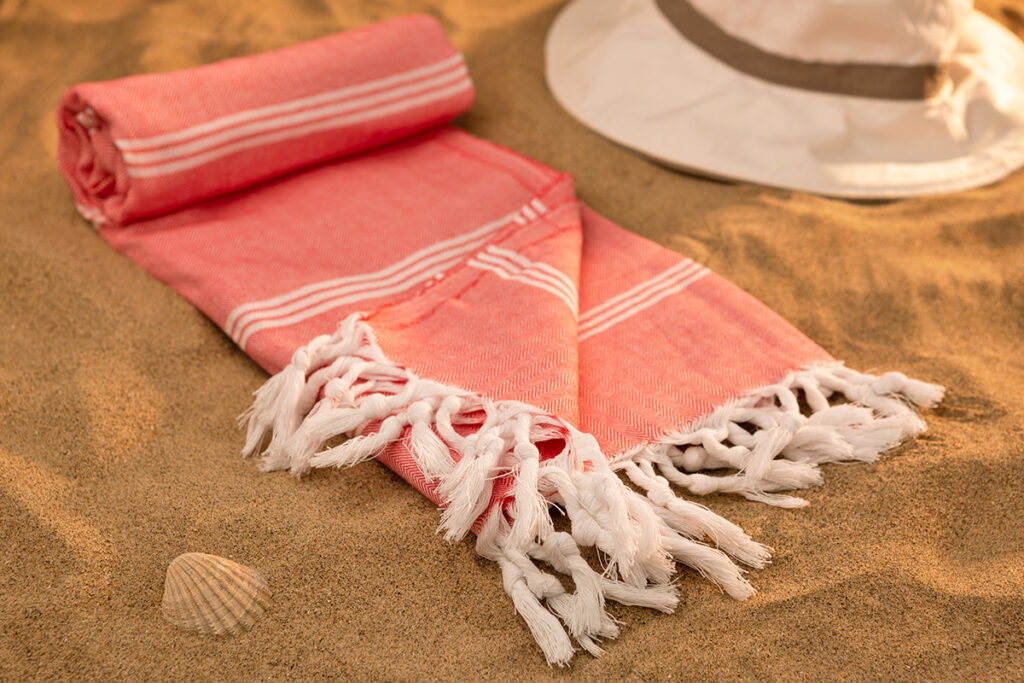
Turkish cotton towels are thinner and more lightweight than traditional cotton towels, so it’s easy to pack a few in your bag. They’ll dry more quickly, and because they don’t have terrycloth’s plush weave, they’re less likely to hang on to sand. They also get softer the more you wash them. 

Advertisement
Advertisement

Turkish cotton towels are likely to cost more than other types of towels up front, but they can last for years with proper care. Wayfair has great options for both Turkish cotton beach towels and terrycloth towels; you can find them here.

Microfiber beach towel
Credit: © edwardolive—iStock/Getty Images

Microfiber

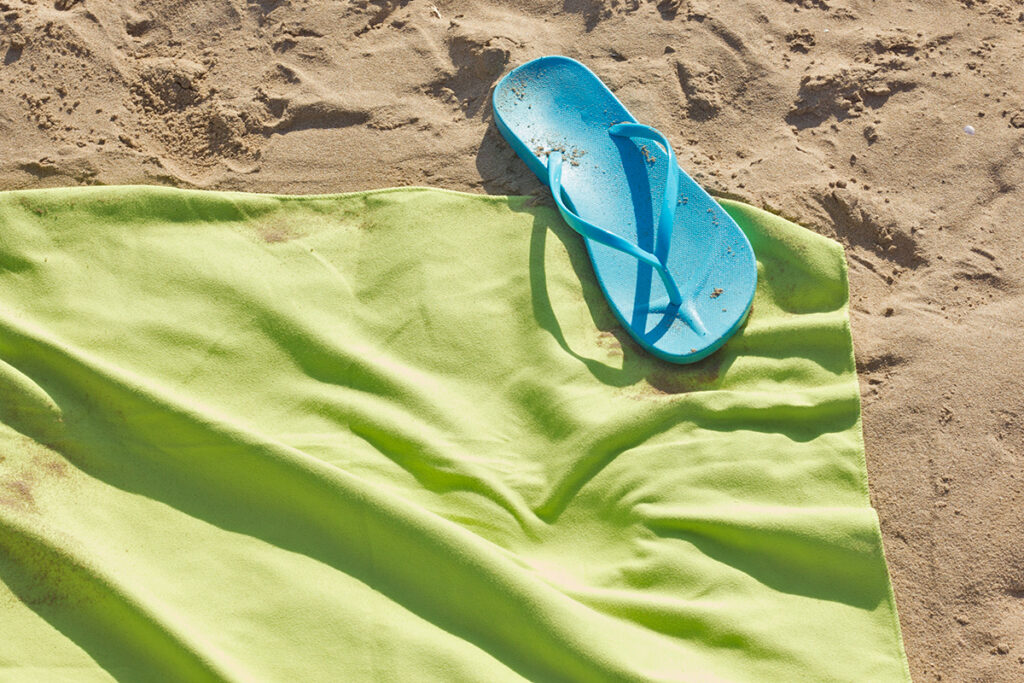
Like Turkish cotton towels, microfiber towels are thin and lightweight, making them easy to stick in your beach tote or suitcase. They’re also incredibly absorbent, capable of holding several times their weight in water, and they’re quick-drying as well, making them a great option for humid environments. The tight weave of microfiber fabric keeps sand away because there are no loops to trap it — you can just shake it off. 

Advertisement
Advertisement

Microfiber towels hold up after repeated washings and can last for years, but because they’re made of synthetic material, they’re also sensitive to high heat, so make sure to care for them properly. 

Microfiber towels might not be right for you, particularly if you prefer a fluffier towel or prioritize natural fibers over synthetics. They’re best if you go to the beach frequently, hike or camp often, or participate in activities that benefit from a compact, lightweight towel that dries quickly. You can find more microfiber towels here.

Advertisement

Featured Image Credit: © Polina Tankilevitch/Pexels

More From Our Network

Better Report is part of Inbox Studio, an email-first media company. *Indicates a third-party property.

Go Retro With This 1960s Fashion Quiz

Quiz Daily

Go Retro With This 1960s Fashion Quiz

True or False: Are You a Master of U.S. Geography?

Travel Quiz

True or False: Are You a Master of U.S. Geography?

5 Reasons You Can Be Denied Boarding an Airplane

Daily Passport

5 Reasons You Can Be Denied Boarding an Airplane

What Did People Do Before Eyeglasses?

History Facts

What Did People Do Before Eyeglasses?

How To Use a Balloon To Clean Up Dust

House Outlook

How To Use a Balloon To Clean Up Dust

11 Shopping Hacks Costco Members Should Know

FinanceBuzz*

11 Shopping Hacks Costco Members Should Know

Share this article

  • Share to Facebook
  • Share to Twitter
  • Copy Url
  • Share to Email
Sponsored Content

This article is for general informational purposes only.
Affiliate Disclaimer Medical Disclaimer Financial Disclaimer

Updated:
Posted In: Home
Hero Image Credit: Better Report

Advertisement

Related Articles

The Most Dangerous Things You Do With Your Christmas Tree

4 min read

12 Foods You Shouldn’t Store Together

6 min read

17 Home Safety Gifts Your Family Actually Needs

10 min read

Should You Refrigerate Peanut Butter?

6 min read

The Most Popular Car Colors in the U.S.

4 min read
Advertisement
  • Home
  • Health
  • Wealth
  • Logo
  • Advertise
  • About
  • Contact Us
  • Privacy Policy
  • Terms of Use
  • Your Privacy Choices
x
Thumb Image

Elevate your everyday.

Sign up to receive the practical tips and expert advice you need to pare down the complexities of everyday living right in your inbox.

Sorry, your email address is not valid. Please try again.

Your email is:

Edit Image
Sorry, your email address is not valid. Please try again.
Thank you for subscribing...

By subscribing you are agreeing to our Terms of Use and Privacy Policy.

Close image
Thumb Image
Second Thumb Image

Elevate your everyday.

Sign up to receive the practical tips and expert advice you need to pare down the complexities of everyday living right in your inbox.

Sorry, your email address is not valid. Please try again.

By subscribing you are agreeing to our Privacy Policy and Terms of Use.

Close image